Encore+ 1 Year on: Supporting a European OER Ecosystem

The EU-funded Encore+ project aimed at promoting the use of OERs for Education, Business and Innovation is coming to the end of its first year. We invite you to read our latest newsletter to learn more about our activities over 2021.

A major highlight of 2021 was our Encore+ Circles supporting critical debates, rich conversations and the sharing of best practices. Some of the learnings and critical reflections from these lively online events are shared through our dedicated Encore+ blog. The NIDL team, led by Dr Orna Farrell, Dr James Brunton and Prof. Mark Brown, focused in 2021 on the challenge of “policy to practice” and back again.

In September, we launched a position paper to generate further discussion on this challenge as part of a wider call to go beyond altruism and lofty rhetoric.

Our project partners, led by the International Council for Open and Distance Education (ICDE), launched several other position papers and hosted related Circle events on Quality, Innovation, OER Technology and Business Models. The good news is that these professional learning Circles will continue throughout 2022 and you can find out more about forthcoming events and activities on the project website.

We would like to take this opportunity on behalf of all the project partners to wish you a happy Festive Season. All the best for 2022 and hopefully we will see you at one of our events in the New Year.

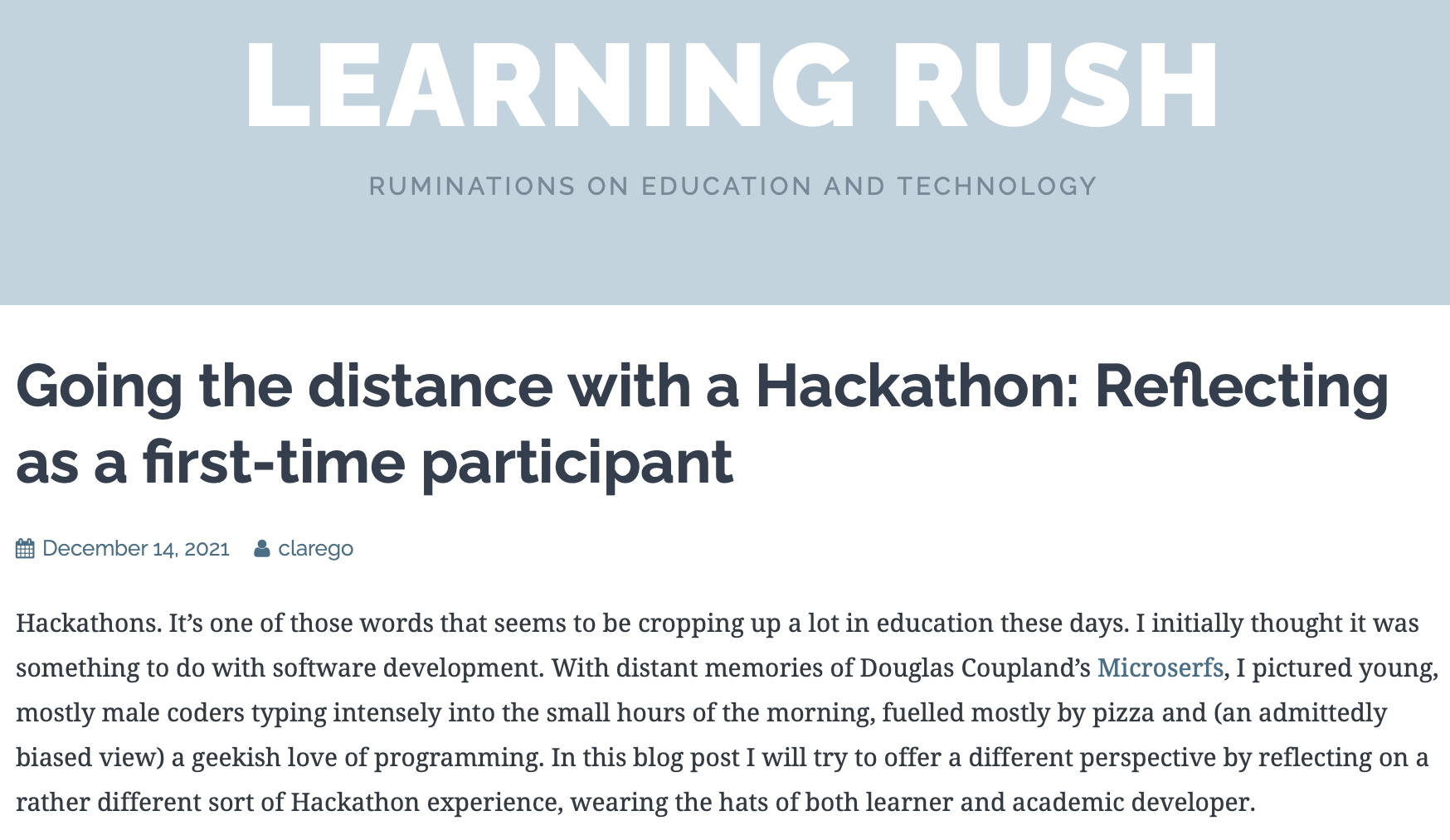
Going the Distance with a Hackathon: Personal Reflections

By Clare Gormley

Hackathons. It’s one of those words that seems to be cropping up a lot in education these days. I initially thought it was something to do with software development. With distant memories of Douglas Coupland’s Microserfs, I pictured young, mostly male coders typing intensely into the small hours of the morning, fuelled mostly by pizza and (an admittedly biased view) a geekish love of programming.

In this blog post I will try to offer a different perspective by reflecting on a rather different sort of Hackathon experience, wearing the hats of both learner and academic developer. 

This motivation to learn more about Hackathons has come from the fact that DCU is engaging in a major curriculum transformation project – DCU Futures – which includes Challenge Based Learning (CBL) as a key pedagogy. CBL is fundamentally about the investigation of real-life problems related to pressing societal issues. It is a pedagogical approach that is increasingly being used in higher education to foster transversal skills, increase knowledge of socio technical problems, and enhance collaboration with industry and community stakeholders (Gallagher & Savage, 2020).

A hackathon is one example of CBL in practice but it can take other forms including projects, design events, or competitions that aim to solve difficult problems. Lyons, Brown & Donlon (2021, p.1) describe a hackathon as an ‘intensive run’ where participants commit to forming collaborative teams to resolve and present solutions to real-world challenges during an allocated period of time. 

Most of us in Higher Education are completely new to the notion of Hackathons and even fewer of us again have actually organised one. Since supporting the design and implementation of CBL is part of the Teaching Enhancement Unit remit, it seemed important to get an authentic experience on how this approach might work. There could be no better way to ‘walk in the shoes of students’, than to get a first-hand experience of a Hackathon for myself.

You can continue to read Clare’s personal reflections on her hackathon experience at her “Learning Rush” blog. After describing the experience she shares a number of pros and cons and then concludes with 10 takeaways for those thinking about planning to integrate hackathons into their teaching in the future.