In early March 2017, this year DCU once again hosted the annual Computers in Education Society Conference (CESI). For the first time the conference shifted from the Glasnevin campus where it was held in 2016 to the St Patrick’s campus and the DCU’s new Institute of Education. Notably, Dr Anne Looney, the newly appointed Executive Dean for the Institute of Education and acting CEO of the Higher Education Authority, was one of the keynote speakers.
The conference attracted a large gathering of Irish practitioners from around the country and this year’s theme of “Making Connections: Transformation through Technology and Teamwork” was evidence throughout the programme. Amongst the DCU and NIDL contributions over the day, Professors Deirdre Butler and Mark Brown gave the following talk (see video below) exploring different conceptions of digital literacy and asking the questions “Are we making the right connections?”
You can view the slide-deck used for this presentation below. We look forward to another engaging and stimulating CESI in 2018.
On 22nd February 2017, the newly completed LEGO Education Innovation Studio (LEIS) was officially opened on DCU’s St Patrick’s Campus. Opened by Jesper Just Jensen, LEGO Education’s lead on innovation and Professor Brian MacCraith, President of DCU, the Studio will act as a dedicated interactive learning hub to help DCU student teachers and Irish schools develop innovative and creative approaches to teaching STEAM (Science, Technology, Engineering, Arts & Maths) subjects in the classroom.
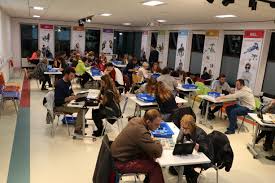
A programme of annual events for learners across the education continuum (primary, post Primary, third level and adults) was announced, beginning with the FIRST LEGO League Jr Leinster and Munster competitions. The League is designed to introduce STEAM concepts to children aged 6 to 10 while exciting them through a brand they know and love – LEGO.
Beyond promoting greater engagement in the area of STEAM through digital forms of learning the initiative has the goal of developing an ethos or mindset of being a future-maker—encapsulated in the strapline of “Let’s Build” which appears on the wall of the Studio.
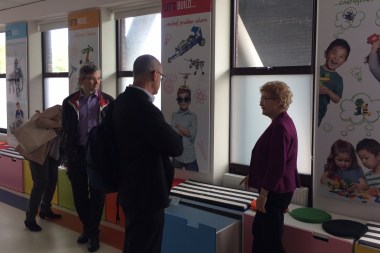
The theoretical and philosophical underpinnings of the Lego Education Innovation Studio are captured in the following defining statements, which appear in the highly visible artwork around the walls.
Inspirational leaders
Enterprising entrepreneurs
Resilient problem solvers
Collaborative thinkers
Curious minds
Courageous dreamers
A sense of wonder
Intelligent challenges
Innovative mindsets
Creative future makers
Professor Deirdre Butler, head of Digital Learning at DCU’s Institute of Education and advisor to the Implementation Group for a National strategy highlighted the Studio as a concrete example of how the recommendations of the Digital Strategy for Schools and the STEM Education Report can be implemented in practice. She reported:
“Following the hugely successful pilot programme, we are very excited to announce both FIRST LEGO League Jr challenges which have the potential to transform how our children learn and engage with the science and technology that surrounds them every day. These innovative learning techniques have been embedded in all our Digital Learning and Science Education programmes, creating a team of LEGO Education champions in DCU’s student teachers. Our added focus now on practising teachers’ professional learning programmes will allow us to significantly build the scale and impact of these learning tools.”



 A programme of annual events for learners across the education continuum (primary, post Primary, third level and adults) was announced, beginning with the FIRST LEGO League Jr Leinster and Munster competitions. The League is designed to introduce STEAM concepts to children aged 6 to 10 while exciting them through a brand they know and love – LEGO.
 Beyond promoting greater engagement in the area of STEAM through digital forms of learning the initiative has the goal of developing an ethos or mindset of being a future-maker—encapsulated in the strapline of “Let’s Build” which appears on the wall of the Studio.
 Inspirational leaders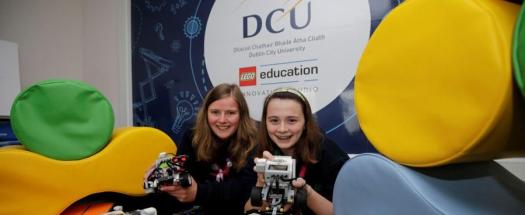
 Digital Learning Dispatches