New Designs for New Times: An Exploration of Learning Spaces

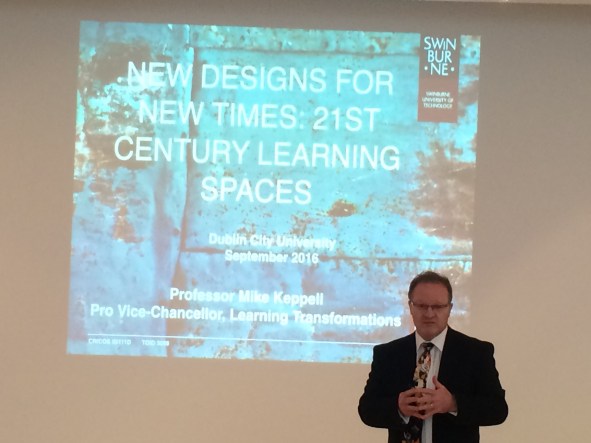
On the 30th September 2016, the NIDL hosted Professor Mike Keppell, Pro Vice-Chancellor Learning Transformations, Swinburne University, Australia. As part of our regular visiting scholar series Mike gave a presentation entitled, “New Designs for New Times: 21st Century Learning Spaces”.
Mike

The presentation explored distributed and personal learning environments across the increasingly seamless spectrum of physical, blended and virtual learning spaces. It argued that higher education in the 21st Century is no longer defined by tangible boundaries of a ‘physical campus’ but by the entire student experience, whether that involves the physical corridors of the campus, attending face-to-face classes, or participating in fully or partially online courses. In addition, the student experience may also involve connecting to virtual environments from home, a local cafe, on the bus or participating in professional practice away from the physical campus. Professor Keppell’s talk explored the diverse range of spaces that can be used to enrich the learning and teaching experience for both academics and students and raised the importance of the need to recognise and purposefully design for the changing nature of learning spaces in higher education.
Motivation in Digital Learning Environments

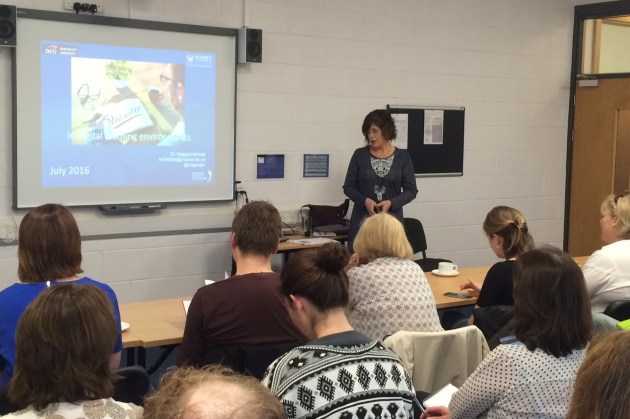
At the end of August 2016, Dr Maggie Hartnett a Senior Lecturer at the Institute of Education at Massey University in New Zealand gave a presentation on the topic of motivation in online learning, as part of the NIDL’s visiting scholar series.

m1.JPG

Maggie argued that with the rapid growth of the internet and related technologies, the way we interact with each other and the world around us is changing. This is particularly true for education where formal and informal online learning opportunities are shifting and changing what it means to learn. Technology enabled learning offers many benefits including the flexibility to fit learning and study around other life commitments. But alongside the freedom to decide when, where and how to learn there are also challenges.

M2.JPG

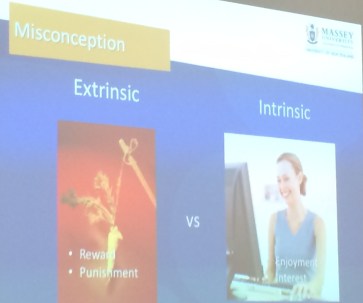
Dr Hartnett’s research shows there are a range of considerations that are crucial to online learner success. Primary among them is motivation. Digital technologies are often viewed as inherently motivating because they provide a number of qualities that foster motivation such as curiosity and novelty. But as Maggie showed the picture is more complex than this as poor motivation has been shown to be a decisive factor in contributing to high dropout and non-completion rates from online courses and MOOCs and is an important impetus for the introduction of game-like elements such as digital badging into courses. In this talk, Maggie dispelled some of the common misconceptions about motivation in the context of recent popular digital initiatives and discussed how our understanding of motivational concepts have changed over the years. She then described what the research tells us about motivation to learn and why it is a crucial consideration in well-designed contemporary digital learning environments.

Dr Hartnett is Associate Editor of the Journal of Open, Flexible and Distance Learning and  her presentation expanded upon a recent Springer book she has written entitled Motivation in Online Education