

In June 2017, two NIDL staff were fortunate to participate in the first OEB Mid Summit conference with a theme of “Shaping the Future of Learning”.
 While this first Mid Summit conference in the OEB series of events did not attract a particularly large number of delegates, as perhaps the organisers would have hoped, on paper the programme included a very strong line up of speakers.

That said, on a less positive note it was observed by several conference delegates how disappointing it was to see in today’s age some of the panel discussions dominated by men. And they tended to be white, middle aged and for some reason came across to the audience as rather angry or disaffected about the state of educational technology and higher education more generally. Perhaps something to note for the next conference.
Dr Mairéad Nic Giolla Mhichíl and Professor Mark Brown from the NIDL jointly presented a challenging paper exploring the utopian and dystopian sides of the digital literacies movement. The presentation was well received by delegates and a copy of the slide-deck appears below.
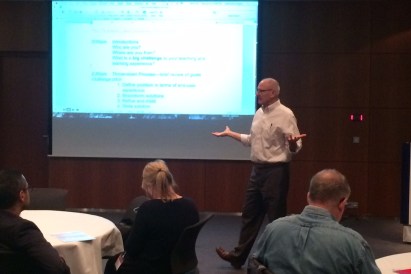 In addition, both Mark and Mairead were pleased to have the opportunity to support Dr. Larry Ragan from Penn State University and Maren Deepwell from the UK Association of Learning Technology to plan and facilitate a very innovative “throw down” challenge workshop on the theme of student success.
 During the workshop participants were challenged in groups to generate ideas to address the problem of student retention, and then had to select their best one to pitch as the most promising educational solution for potential funding and future development. We heard some excellent pitches and the workshop was a great success, thanks to Larry’s expert facilitation. Whether the NIDL has a presence at OEB Mid Summit 2018 remains to be seen.
 More recently Kirschner and Neelen (2017) argue that many so-called learning analytics initiatives: (i) view education as a simple process that is easily modelled; (ii) base decisions and interventions on data rich but weak theory; (iii) inform decisions and interventions based on wrong or even invalid variables; (iv) make interpretations and arrive at conclusions that confuse correlations with causality; and (v) result in unintended and unwanted effects that pigeonhole and stereotype learners which may be counterproductive to enhancing student engagement and learner success. Arguably, to date there has not been a serious or comprehensive response to these justifiable concerns.
 Digital Learning Dispatches