

In early May 2017, Professor Mark Brown was the keynote speaker at a conference in Amman, Jordan as part of a European funded Tempus project on enhancing the quality of technology-enhanced learning.  The event also served to mark the launch of a new National e-Learning Centre at Princess Sumaya University for Technology (PSUT). Deputising for HRH Princess Samaya, the PSUT’s President, Mashhoor Al Refai, is reported in a brief story in the Jordan Times as commending the university’s efforts in building the Kingdom’s academic community’s e-learning capacity and the role of new digital technology in raising the quality level of education in Jordan.
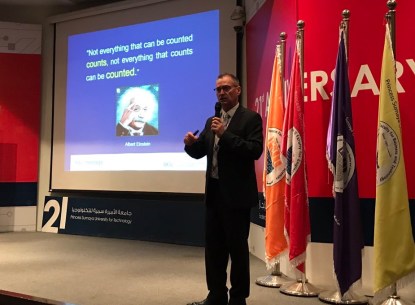 In his opening keynote address, Mark explores different quality models using an interesting ice-cream metaphor, which happens to be a Syrian delicacy that is popular and widely available in Jordan. Professor Brown will be a member of the International Advisory Board established to support the work of the new National e-Learning Centre.
A copy of Mark’s keynote slide-deck is available below.

 Digital Learning Dispatches