
On the 27th of January the #Openteach project team in the NIDL led by Dr Orna Farrell hosted a seminar about teaching online. This seminar was funded by the National Forum for the Enhancement of Teaching and Learning in Higher Education.

The aim of the seminar was to explore effective online teaching practice and how to support the professional development of online educators. The seminar featured two very interesting guest speakers: Professor Elena Barbera from the Universitat Oberta de Catalunya, and Dr Helen Coker from Queen Margaret University Edinburgh.
Time in online education
 Professor Barbera spoke about her research on the role time plays in online education. She outlined her ideas about the online time paradox: that students enrol in online courses because they don’t have enough time to go to a campus based course, but the remaining time that the student has to study is low quality, and they may end of up dropping out due to to the lack of time they had to begin with.
Barbera described how this consideration of time is woven throughout their approach to online education at the Universitat Oberta de Catalunya.

Being an online lecturer
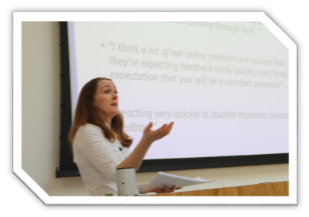 Dr Helen Coker’s talk focused on her journal article “Purpose, Pedagogy and Philosophy: “Being” an Online Lecturer”published in IRRODL. Coker’s study took an ethnographic approach to exploring the lived experiences of online educators. She identified three approaches to online teaching practice: knowledge, affect, and dialogue, as illustrated below.
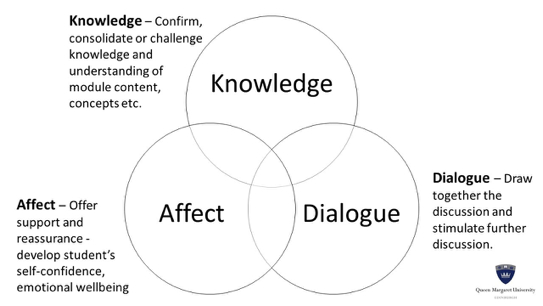
These three approaches were found to be mutually constituting, one could be brought into focus but the rest were still there.
Social presence: Scenario 1 of #Openteach
 The final part of the workshop was an interactive session on social presence facilitated by the #Openteach project team. The aim of this session was to pilot the first scenario from the #Openteach short online course.
Participants were presented with a scenario related to the topic of social presence in online teaching and worked through a scaffolded activity designed to prompt discussion about approaches to establishing and maintaining presence online.
Join #Openteach
 If you are interested in taking part in the #Openteach short online course about teaching online which will run from the 23rd of March to the 3rd of April 2019 and will take approximately 10 hours to complete. The course is open to anyone with an interest in online teaching. You can register your interest https://openteach.ie/join-openteach/ or email orna.farrell@dcu.ie for more information.
Final thoughts
Overall the seminar was well received by participants, and was a good opportunity to open up dialogue and discussion about teaching online in Irish higher education. All of the resources from the seminar are available from the #Openteach website:
 On the 15th April at 2pm in DG10 in Bea Orpen on Dublin City University’s Glasnevin campus,
  Dr. Julie-Ann Sime, Lancaster University
 Dr. Chryssa Themeli, Lancaster University
 Digital Learning Dispatches