

At the end of August 2016, Dr Maggie Hartnett a Senior Lecturer at the Institute of Education at Massey University in New Zealand gave a presentation on the topic of motivation in online learning, as part of the NIDL’s visiting scholar series.
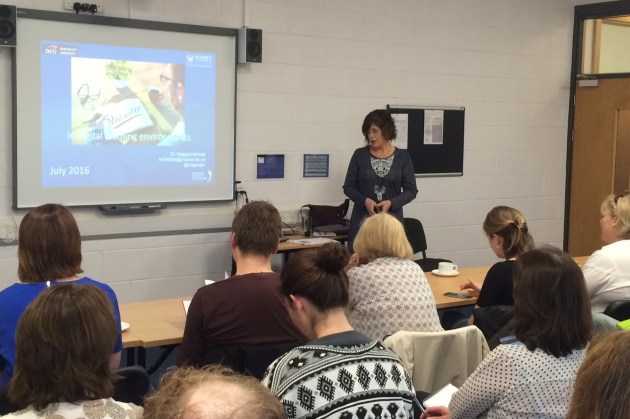
Maggie argued that with the rapid growth of the internet and related technologies, the way we interact with each other and the world around us is changing. This is particularly true for education where formal and informal online learning opportunities are shifting and changing what it means to learn. Technology enabled learning offers many benefits including the flexibility to fit learning and study around other life commitments. But alongside the freedom to decide when, where and how to learn there are also challenges.
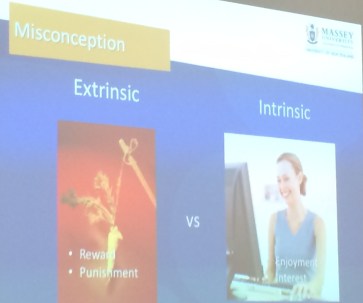
Dr Hartnett’s research shows there are a range of considerations that are crucial to online learner success. Primary among them is motivation. Digital technologies are often viewed as inherently motivating because they provide a number of qualities that foster motivation such as curiosity and novelty. But as Maggie showed the picture is more complex than this as poor motivation has been shown to be a decisive factor in contributing to high dropout and non-completion rates from online courses and MOOCs and is an important impetus for the introduction of game-like elements such as digital badging into courses. In this talk, Maggie dispelled some of the common misconceptions about motivation in the context of recent popular digital initiatives and discussed how our understanding of motivational concepts have changed over the years. She then described what the research tells us about motivation to learn and why it is a crucial consideration in well-designed contemporary digital learning environments.
Dr Hartnett is Associate Editor of the Journal of Open, Flexible and Distance Learning and her presentation expanded upon a recent Springer book she has written entitled Motivation in Online Education.
 One such visitor was
  While it is true that, in most cases, teachers and lecturers are happy to have their notes and PowerPoints shared online, there are often exceptions. Examples of this include, but are not exclusive to, a YouTube video with several hundred thousand hits, a popular book, or a MOOC course on the platform
  Digital Learning Dispatches