

By Dr James Brunton
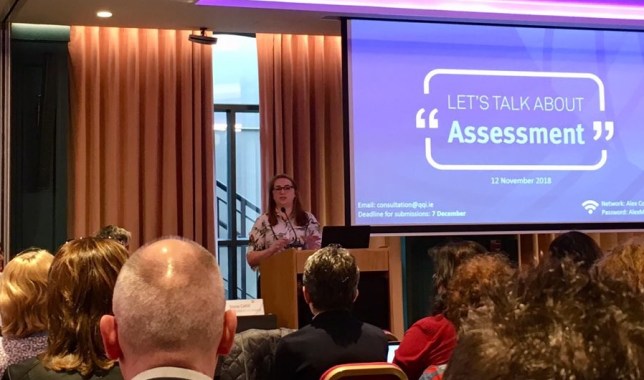
On the 12th November the Quality and Qualifications Ireland (QQI) / National Forum for the Enhancement of Teaching and Learning in Higher Education event, ‘Let’s talk about Assessment’, took place in Dublin. The event brought together representatives from across the Irish higher education and training sector for a discussion of issues relating to the assessment of learners and learning, with the aim of facilitating the development of submissions to QQI on their Green Paper on Assessment. It was a highly interesting event, with Professor Lambert Schuwirth giving an insightful keynote and closing address, and four breakout sessions exploring key issues of: Programme Assessment and Feedback; Work Based Assessment and Feedback; Diversifying Assessment; and Thinking about Assessment in a Digital World.

I had the pleasure of facilitating the Thinking about Assessment in a Digital World session, and feeding some of the outputs from that session back to the attendees in the closing plenary session. In order to keep these conversations going I want to further report on the discussions from the session here.
Those attending the Thinking about Assessment in a Digital World came from all parts of the sector and had varying amounts of experience with ‘digital assessment’, either through using technology to enhance existing assessment practices or in creating and delivering assessments in an online context. The sessions attendees reported that they saw the digital world as bringing many opportunities and affordances: more flexibility for students; allowing for a diversity of assessment types; facilitating a diversity of students; or allowing for effective feedback through technology (e.g. online rubrics); etc. However, attendees were also worried about a lack of reliable, robust, secure infrastructure in terms of both the physical and virtual technology and human supports. The human supports were conceptualised as having the support of learning technologists and/or that continual professional development would be provided to staff, depending on the approach to teaching and learning that was dominant in different institutions.
Another source of worry for attendees was that the potential opportunities and affordances in this digital world are not inevitable. Attendees highlighted the need for supportive national guidelines, e.g. clear definitions of the various study modes and guidelines for fully online programmes. Attendees also highlighted the need for cohesive institutional policies and quality assurance processes to be in place relating to digital assessment delivered in different study modes. A key point was that if such policies and processes were not in place that teaching and learning models used for on-campus, face to face teaching would be used for blended/online study. Attendees were concerned about institutional supports being in place to support staff to develop skills for this space, that they should be supported to be innovative even though this might bring with it the risk of (at least initial) failure. The need to scaffold students digital readiness was also discussed.
The final point from the session that I will report was that attendees spoke of the ongoing work in which many people are engaged in the sector, often feeling that they are doing it in isolation and without sufficient resources. It was emphasised that we need to recognise this work and seek ways in which to work together in order to move the whole sector forward and not rely on ‘long wolf’ enthusiasts.
Note: James first posted his report and reflections on this event on his personal Linkedin account.

 Digital Learning Dispatches