

It has been a busy week for our team as the DSTEP Winter School, organised as part of the ‘Developing Staff to Enhance Programmes’ (DSTEP) project, got off to a great start on Monday 22nd January with an open seminar on the use of gamification techniques for teaching Psychology.
The DSTEP project aims to provide continuous professional development for psychology educators with a specific focus on gamification, that is, the incorporation of game design elements in an educational context to enrich the learning environment. Gamification can be contrasted with game-based learning, as gamification does not imply the use of games necessarily, but rather using the principles and mechanics of games (e.g. incentives or points, immediate feedback, the freedom to make mistakes, freedom to choose pathways etc.) to offer an engaging teaching experience for learners. The image below – reproduced from a report published by the Observatory of Educational Innovation (2016) – shows how gamification can be distinguished from game-based learning and serious games:
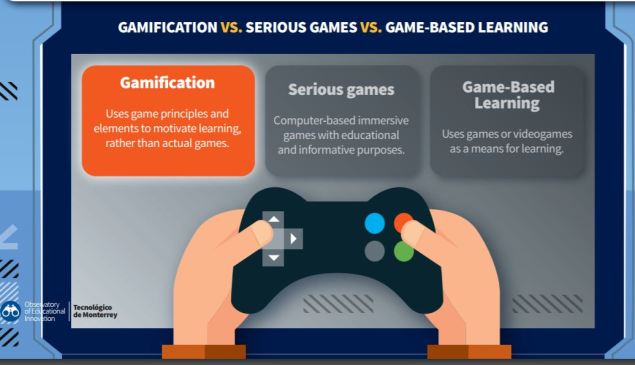
For a comprehensive and accessible introduction to gamification, see this report published by Observatory of Educational Innovation (2016).
Monday’s seminar kicked off with a fascinating presentation from Dr Rebecca Sharp (Bangor University) on her experiences of gamifying the teaching of a Behavioural Psychology undergraduate module. Rebecca adopted a ‘dystopian future’ themed approach to gamifying the module, prompted by poor attendance and a lack of student engagement with a more traditional approach to the teaching of the module.

The short clip below summarises some of the gamification techniques used by Rebecca, including the framing of learning tasks as ‘missions’ for which ‘rewards’ could be won, the opportunity to ‘replay’ online learning tasks to achieve mastery of a subject and the provision of choices to learners such as the selection of their assignment topic and voting to reveal selected exam questions.
Analysis suggests that most (but not all) learners enjoyed the gamified approach to the module and it led to increased attendance and attainment when compared to more traditional approaches to the module. To watch Rebecca’s presentation in full, including a more complete analysis of the impact of the gamification on student learning and engagement, click here.
This keynote presentation by was followed by a panel discussion and Q&A featuring Dr Gearóid Ó Súilleabháin (Cork Institute of Technology), Dr Rebecca Sharp (Bangor University), Mr Gavin Henrick (Moodle) and Dr Lorraine Boran (Dublin City University).  A lively discussion ensued which examined a range of issues relating to gamification including: the role of intrinsic and extrinsic motivation in driving student learning; ethical concerns in relation to gamification and the risk that competition and ranking might prove harmful to learners; the importance of gamification being underscored by meaningful learning activities which support student learning; and the need for more research to inform the design and implementation of a gamified learning environment in Higher Education contexts.
The call for more research is echoed in the conclusions of a recent literature review on the topic of gamifying education, which was recently selected as one of the NIDL’s top 10 open access journal articles for 2017.
Monday’s seminar took place as the opening event of a Gamification Winter School, hosted by the Teaching Enhancement Unit to offer professional development for Psychology educators, focused particularly on the use of gamification approaches to enhancing learning, teaching and assessment. The two-year DSTEP project is externally funded by the National Forum for the Enhancement of Teaching and Learning in Higher Education.
 On Tuesday a large group of friends, colleagues and invited guests, including the

 Professor
 Professor
 A programme of research is also associated with this initiative which builds on the NIDL’s growing reputation in this burgeoning area, as evidenced by DCU being selected to host the
  Finally, we would like to acknowledge the
  Digital Learning Dispatches