Successful Launch of Loop Reflect: DCU’s New Learning Portfolio

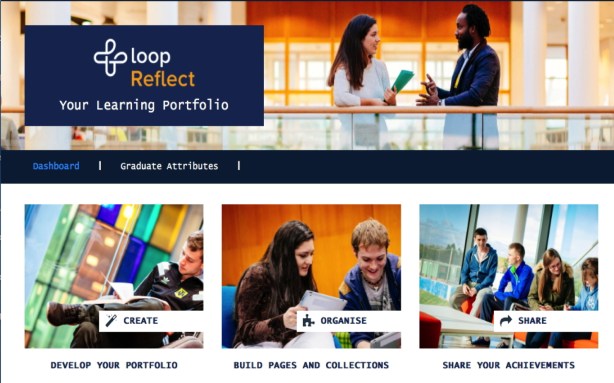
We recently launched under the leadership of Lisa Donaldson and Dr Mark Glynn in the Teaching Enhancement Unit in the NIDL our new learning portfolio known as Loop Reflect.

Reflect1

The new platform, based on a customised version of Mahara specifically designed to meet DCU’s requirements, aims to support students to critically reflect on and share their academic, professional and personal achievements.  In this respect the learning portfolio is intended to help students demonstrate their ability to meet DCU’s Generation 21 Graduate Aspirations, and support meaningful employment on graduation and a wider commitment to life-long and life-wide learning.  The goal is to create a living portfolio which will help develop critical reflection as a “habit of mind” and assist future employers in visualising the breadth of a DCU student’s capability and learning experience.
Reflect2.jpg

The launch event for Loop Reflect was attended by Minister for Education & Skills, Mr Richard Bruton TD, and marks the completion of the pilot phase of Reflect which has seen more than 5,000 students sign up to use the learning portfolio across a range of disciplines and in a range of different contexts. Professor Brian MacCraith, President of DCU explained the importance of this new initiative:

“DCU is committed to providing its students with a transformative learning experience, that will enable them to flourish in the workplace and society.  The world of work requires citizens with transferable skills who are resilient and adaptable, and capable of reflective and critical thinking.  The Reflect portfolio challenges traditional approaches to teaching, learning and assessment, capturing all facets of student learning and providing our students with an opportunity reflect on their personal and professional as well as learning development.”

Exploring the Underbelly of Digital Literacies

By Professor Mark Brown

Digital Literacy is essential for successfully living, learning and working in today’s increasingly digitalised and rapidly changing world. This brief think piece is written on the assumption that most people would agree with this statement.

However, what we define or understand as digital literacy is far more problematic. As Lankshear and Knobel (2008) observe in their seminal book on the topic, ‘the most immediately obvious facts about accounts of digital literacy are that there are many of them and that there are significantly different kinds of concepts on offer’ (p.2). Therefore, in many respects it helps to talk of digital literacies rather than limit our thinking to a singular all-inclusive definition of the concept. In a similar vein, in both the academic and popular literature the language of digital literacies is often interchanged and/or intentionally expanded through terms like digital skills, digital fluency, digital capabilities, digital competencies, and so on. The different use of terminology and nomenclature makes the search for a commonly agreed definition or understanding of digital literacies even more elusive.

piglet-1332262_960_720

Key takeaways

Set against this messy backdrop of competing definitions, models and frameworks, this blog post prior to OEB MidSummit explores the often unspoken underbelly of digital literacies. There are three core messages woven throughout this critical discussion about what it means to be digitally literate in the 21st Century. Firstly, the definition of literacy in whatever form is inherently political. Secondly, the digital literacies movement is complex and many efforts to propose definitions and develop related models and frameworks are decontextualised from social and situated​ practice. Lastly, most models and frameworks for digital skills, literacies or competencies fail to adequately address some of the powerful macro-level drivers and entangled and contradictory discourses behind the goal of preparing more digitally skilled learners, workers and citizens.

You can read more about the underbelly of digital literacies by reading the full OEB Insights blog post where this think piece was originally published.