
Last week, Dublin City University (DCU) and Europe’s leading online social learning platform, FutureLearn, announced a global strategic partnership to help meet the fast-growing demand for career-long, work-ready, flexible life-long learning. DCU’s collaboration with FutureLearn will enable the University to remain at the forefront of the digital learning and teaching movement that is helping to transform traditional models of higher education.
The partnership is DCU’s response to increasing local and global demand for lifelong and micro-learning opportunities from reputable universities as people seek to enhance their skills, competencies and knowledge to thrive in the workplace and society.  This unique global partnership will enable DCU to leverage a large and rapidly growing international community of online learners whilst also developing a rich digital learning experience for DCU’s on-campus students. In the case of campus-based education the intention is that the partnership will also act as catalyst to transform the University’s approach to curriculum design and programme development with a global impact. Offerings will range from short courses to micro-credentials of smaller credit values to full Postgraduate awards across disciplines.
The reality is that online learning is now an established part of the global higher education eco-system. The number of students learning online in the US is now over 6 million (Allen & Seaman, 2018). In 2015 the global value of online learning reached almost €100 billion and this is predicted to be around €300 billion in the next 5-years (McCue, 2019). The global market for MOOCs alone, which was valued at €3.5 billion in 2018, is predicted to reach around €20 billion by 2023 (MOOC Market, 2019). In 2018, over 100 million people worldwide registered for a free online course through one of the major MOOC platforms and this figure is closer to 130 million when local platforms from India and China are taken into account (ClassCentral, 2019).
 Australia’s recently launched International Education 2025 Roadmap (2016) estimates the size of the “untapped” borderless skills market which can be serviced by online and blended approaches to be in excess of one billion students. The growing demand for lifelong learning is reflective of an increasingly aging global population. Those aged 65+ will increase by 35% by 2025 thus constituting 10% of the total global population: China and India will have the largest population in this age segment, the highest growth though will be in the Middle East notable in the UAE and Saudi Arabia (Euromonitor, 2014).

As previously mentioned, the partnership enables DCU to offer a range of short and longer accredited courses from micro-credentials to postgraduate degrees aimed at working professionals and global learners. The courses will cover a wide variety of subjects: from Artificial Intelligence to Irish Language and Culture, to FinTech for Business Leaders. Over 45,000 learners from 136 countries have already participated in DCU’s suite of online Irish Language and Culture short courses, Fáilte ar Líne, on the FutureLearn Platform. The initiative was co-funded by the Department of Culture, Heritage and Gaeltacht, under the Twenty-Year Strategy for the Irish Language with support from the National Lottery.
 The announcement of the global partnership was made at the “Leading Learning Futures Forum” held at DCU on Wednesday June 12th and attended by the President of DCU Professor Brian MacCraith, Simon Nelson, CEO of FutureLearn, and attendees from the education and technology sectors. The forum offered a global perspective on the future of higher education and specifically how Ireland can respond to and harness the opportunities that arise from this. The partnership with FutureLearn will be coordinated through the Ideas Lab in the National Institute of Digital Learning (NIDL) at DCU.
Announcing the initiative, DCU President Professor Brian MacCraith said:
 “I am delighted that DCU has become one of a small number of global university partners of FutureLearn. This partnership further strengthens DCU’s commitment to increasing educational opportunity, and supporting a culture of innovation in learning. By delivering a wide range of flexible, technology-enhanced programmes, we can ensure DCU remains at the cutting edge of education’s digital revolution. Through this partnership, DCU will deliver a broad range of offerings to learners around the globe, from short courses to micro-credentials, to full postgraduate awards.”
Simon Nelson, CEO of FutureLearn, said:
 “FutureLearn’s mission is to transform access to education — at all stages of life. Career long, flexible learning is more important now than ever before as only by upskilling, and in some cases reskilling, can we hope to successfully navigate the ever-changing professional landscape. Our global strategic partnership with DCU will help us address these challenges head on. We’re delighted that DCU shares our commitment to lifelong and micro-learning, and across such a wide range of disciplines, and are really excited about the opportunities this partnership will offer our global community of learners.”
Professor Mairéad Nic Giolla Mhichíl of the Ideas Lab, DCU said:
“The future of work is changing rapidly. Working professionals need opportunities to learn which respond to the challenges of flexibility, access and relevance. DCU is helping to shape this learning environment through our partnership with FutureLearn. We are also excited about what we can learn from global learners and how we can improve the design and support of digital learning on a global scale.” DCU as one of a handful of global university partners will develop and deliver a variety of PG offerings and awards via the FutureLearn platform.

In introducing the panel discussion, following the official launch, Professor Mark Brown, NIDL Director, said:
“While this new initiative helps to bring learners right into the heart of the University, and what we do, it also enables us to take the best of DCU out to our communities, and beyond—globally.”
Professor Edel Conway from the DCU Business School and Mark Lester, Global Head of Education Partnerships at FutureLearn, then reflected on a number of future-focussed questions during the panel discussion, including: Is a university degree enough? What is the place of micro-credentials? Will they have currency? How should the suite of traditional credentials offered by universities evolve to help meet the changing needs of today’s students for the 21st Century?

You can read DCU’s and FutureLearn’s official press releases announcing this exciting new initiative at the following websites…
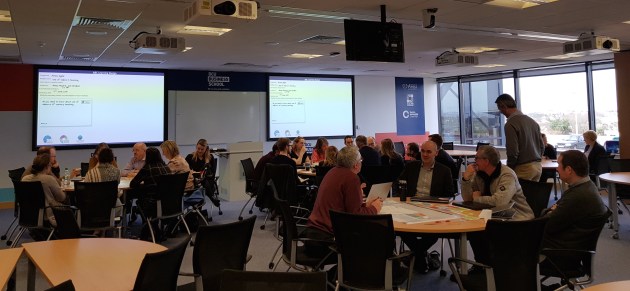

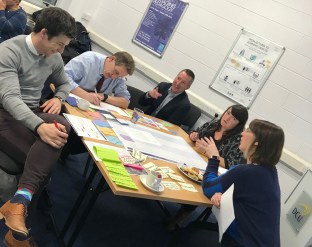 At DCU we have adapted the ‘classic’ materials to suit important strategic priorities such as flexible learning modes, enhanced feedback mechanisms, and Universal Design for Learning (UDL). Furthermore, by using the approach with several teams, evaluating it, and learning how different aspects perform on the ground, we hope to continue to develop our own expertise in using the approach in different contexts. We also plan to do our bit to promote conversations amongst the Irish learning design community about using and tailoring the method to optimum effect.
 Digital Learning Dispatches