Motivation in Digital Learning Environments

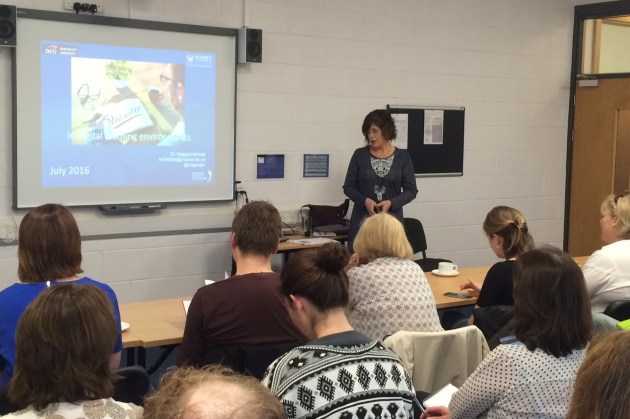
At the end of August 2016, Dr Maggie Hartnett a Senior Lecturer at the Institute of Education at Massey University in New Zealand gave a presentation on the topic of motivation in online learning, as part of the NIDL’s visiting scholar series.
m1.JPG

Maggie argued that with the rapid growth of the internet and related technologies, the way we interact with each other and the world around us is changing. This is particularly true for education where formal and informal online learning opportunities are shifting and changing what it means to learn. Technology enabled learning offers many benefits including the flexibility to fit learning and study around other life commitments. But alongside the freedom to decide when, where and how to learn there are also challenges.
M2.JPG

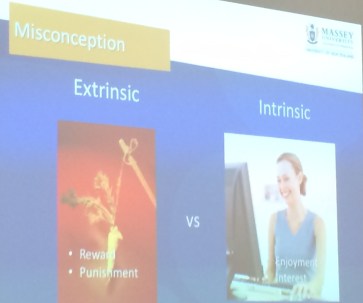
Dr Hartnett’s research shows there are a range of considerations that are crucial to online learner success. Primary among them is motivation. Digital technologies are often viewed as inherently motivating because they provide a number of qualities that foster motivation such as curiosity and novelty. But as Maggie showed the picture is more complex than this as poor motivation has been shown to be a decisive factor in contributing to high dropout and non-completion rates from online courses and MOOCs and is an important impetus for the introduction of game-like elements such as digital badging into courses. In this talk, Maggie dispelled some of the common misconceptions about motivation in the context of recent popular digital initiatives and discussed how our understanding of motivational concepts have changed over the years. She then described what the research tells us about motivation to learn and why it is a crucial consideration in well-designed contemporary digital learning environments.

Dr Hartnett is Associate Editor of the Journal of Open, Flexible and Distance Learning and  her presentation expanded upon a recent Springer book she has written entitled Motivation in Online Education

Making a Software Development Career Change

By Dr Eamon Costello

Many software developers will have Bryan Adams nostalgia moment about when and where they bought their “first real six string”. For me, it was books. A red Wrox book on VBA for MS Access, a very fat book on XML, a java book with a tiger on the front.

I didn’t formally study computing. My primary degree was in English and History. It was when I started working in software development that I decided I needed to go back and do a conversion course. Although I had built up the skills, and could develop software in multiple languages, I did feel a “glass ceiling” of sorts hovering over me. Colleagues on my Higher Diploma in Computer Science course came from diverse backgrounds – the veritable butcher, baker and candlestick maker. The maths graduate, the engineer, the business analyst and me, the rogue arts grad.

Spring2

Now I’m on the other side of the fence. I am privileged to be an educator in an area that I am passionate about. Software development is one of the continued success stories of our economy. While the dodgy GDP rates and accounting practices of multinationals may make the headlines, the reality is that there are many thousands of people working in a very vibrant industry in Ireland in a diversity of roles and companies.

This year, for the first time, the Government have funded part-time ICT conversion programmes. DCU will be running a Higher Diploma in Software Development over two years for those already in employment. Moving sidewise in a career can be tricky but being able to both study and work towards that goal is very important. Morever the Government are funding the student fees. This course, and others like it, should really help build a pipeline of skilled graduates in software development.

Although it is a challenging and intensive course of study we believe the mix of tools, technologies and techniques that students will learn will help give them an edge in the labour market. Although applicants must have a degree in a non-computing area, the key requirement is passion. You will know if it’s for you or not.

The “Summer of ’69” is not a great metaphor as you don’t need to have been programming a ZX spectrum since you were 12 to have a rewarding career in software development. The industry will benefit most from a diversity of practitioners.

Applications are now being accepted for the fully-funded Higher Diploma in Science in Software Development at DCU. For more information and to apply check out https://www.springboardcourses.ie/details/4531

The original article was first ublished by Dr Eamon Costello on his Linkedin account.