Meet you at The Sipping Point

By Clare Gormley

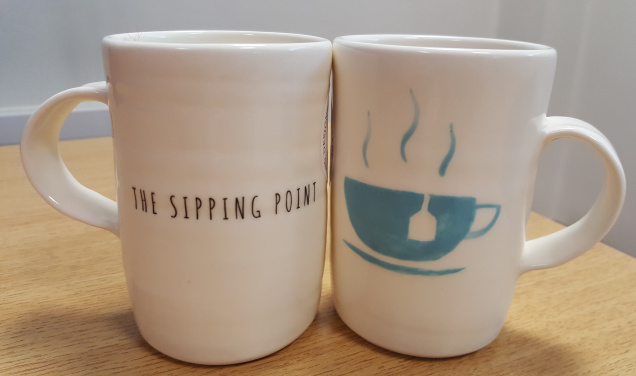
In this post I would like to share some early reflections on The Sipping Point community which recently started up at DCU. Drawing loosely on the concept of Wenger’s community of practice, the idea of The Sipping Point is to provide an opportunity for staff with a shared interest in teaching to interact with each other in a non-formal setting. The basic premise is to try to foster a climate where staff across all disciplines can potentially learn from colleagues about aspects of teaching practice. The result so far is a gathering of members who meet up for one hour once a month to hear about and discuss various approaches that peers are adopting in their teaching context.
Cups

Why this format?

Based on feedback and research into various academic professional development (APD) courses offered by our unit, (you can read more about those in Gormley, O’Keeffe & Ferguson (2017)), it is clear that not all staff can or wish to commit to the timeframes involved in our accredited offerings. Even for those who do complete these courses, there are limited opportunities for a cohort to continue their learning community and interact further once the module(s) have completed. Once-off workshops are also problematic since they don’t tend to engage lecturers deeply over a period of time. And I think it’s fair to say that we have also noticed a general lack of awareness of what other lecturing staff at DCU are doing that might be of value/interest across the academic community.
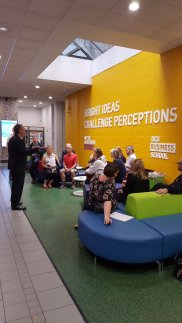
DF0lbKeXgAAEL1eHence The Sipping Point – a new avenue for like-minded souls interested in discussing teaching practice – came into being in April of this year, driven by an enthusiastic combination of positive change, collegiality and coffee. The general format is a one-hour session led by at least one lecturer presenting on a predetermined aspect of their practice for 10 minutes. After that, the topic goes open to the floor for general questioning and discussion. We meet at all three DCU campuses (Glasnevin, St Patrick’s and All Hallows) over the last week of the month.

You can read more about the Sipping Points initiative on “Learning Rush“, Clare’s Gormley’s personal blog.



Decoding the Future of Work and ICT Education (of Peig and Programming)

By Dr Eamon Costello

Coding is the next new blue collar job! Get kids coding! You may have heard the headlines. Writing code, it would seem, can lead to steady well paid work. Our children should be taught more of this key skill earlier in life. Or so we are told.

The reality is messier. Not least because, as Yogi Berra put it: prediction is hard, especially about the future. My colleague Professor Mark Brown has explored this topic recently in talking about the jobs myth. I agree with one of his main points: take whatever prognostications you hear about future jobs with a decent grain of salt. Any social system is almost by definition too complex to be predicted. The full extent of the future jobs market in software development, just like any other area, can’t be called. My guess however is that the creative and social practice we call coding will be a key part of our economic future (as long as skynet doesn’t snaffle up all our jobs). The problem solving, critical thinking and analytical skillset that the development of software involves will continue to be highly valuable to worklife. To be clear I am not necessarily arguing that computational thinking is a highly transferable or transversal skill. Just that it a very useful one, even if only within the realm of ICT. Because, the thing is, ICT is everywhere now.

EC

What about the present?

That’s the future sorted but what about the present? Reports from Ireland’s Higher Education Authority continue to highlight that in Ireland ICT graduates have the highest rates of employment among graduates and command some of the highest starting salaries. These stats often make headlines. Less often noted however is the puzzling almost paradoxical high rates of unemployment among certain ICT graduates. It depends on how you slice the figures but this phenomenon is not confined to Ireland and a study of the phenomenon in the UK found that perceived reputability of institution, but also worryingly membership of under-represented groups, to be underlying factors. The basic lesson is that although employment prospects for ICT graduates are very good on average, it’s not a sure thing for everyone. Applicants need to think through their choices and the higher education sector needs to work to improve long-term outcomes for all learners.

Related to the issue of diversity is the general perception people have of ICT jobs. Do you need to be a geek to learn to code? Do you need special powers? It’s not easy and it takes time and application but it is open to anyone. Anyone. The track record for diversity in ICT is currently not good and we need to change that. That is part of the impetus for trying to integrate more coding and computer science into curricula at all levels in Ireland now, such as the Coding short course at junior cycle and the brand new Computer Science subject for Leaving Certificate. Its potential for widening opportunity is one of the counter arguments to those who fear a neo-liberal agenda at work, insofar as we may be allowing economic concerns to drive educational ones. Closely allied is the educational danger that we rush headlong into this effort with a pedagogical approach that dulls rather than ignites curiosity. As Papert (1980, p. 5) once warned us, we need to be careful not to end up with the computer “being used to program the child”.

You can read more of this article on Dr Eamon Costello’s Linkedin account.