
While there has been a steady growth in demand for online courses in the last decade, the Covid-19 pandemic has accelerated the uptake of online education across the globe. With millions of people starting or continuing their higher education online this year, there has never been a greater need for a course that teaches the essentials of being an online learner. DCU’s latest online course developed by a team in the National Institute for Digital Learning (NIDL) in partnership with FutureLearn addresses just that – the fundamentals of being an effective online learner.
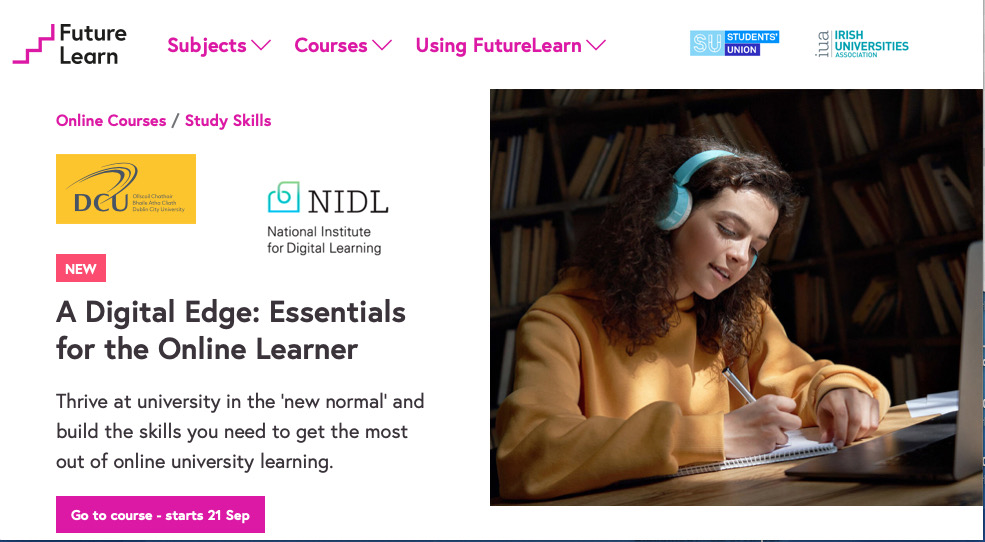
A Digital Edge: Essentials for the Online Learner is a two-week course designed and facilitated by experienced online educators and digital education researchers at DCU working in collaboration with the DCU Students’ Union and the Irish Universities Association (IUA). Funded as part of DCU’s Covid-19 Research and Innovation Hub, this free online course is available to people worldwide.
While there are a handful of similar courses already available online, DCU’s course is unique as it was co-designed to be ‘for students, by students’. This means that while the facilitators are seasoned online educators in the NIDL, the course has been reviewed by IUA student interns from 7 Irish universities and is being co-facilitated by a team of DCU Student Ambassadors. These students will be sharing their own tips, advice and valuable first-hand experiences throughout the course to enable participants to optimise their own online learning journey.
Based on contemporary theory and research along with DCU’s considerable experience in designing online education, the course aims to help students thrive in the new digital-era. It promotes healthy online learning habits and the concept of digital well-being to flourish as online learners for the new digital future. The course helps learners to understand how to truly harness digital tools and resources to maximise their learning and to develop online support networks. Learning to work effectively online in collaboration with peers is a important theme throughout the course. Another key area discussed towards the end of the course is the need to establish and manage a professional online identity.

Led by Professor Mark Brown, NIDL, Director, Professor Mairéad Nic Giolla Mhichíl, Head of the Ideas Lab, and Dr Eamon Costello, Head of the Open Education Unit, the course draws on UNESCO’s Learning Compass 2030 and is anchored in the European LifeComp Framework. It is structured around four key themes and builds on DCU’s strategic collaboration with FutureLearn following the launch of a pioneering new micro-credentialing initiative earlier in the year.
Mark Brown says,
“Online learning is now an important life skill. Even before Covid-19 the level of demand for online education was growing exponentially, worldwide. We hope this course will make a valuable contribution to students starting their online learning journey at university for the first time.”
The course should also be of value to existing students and help people irrespective of age take advantage of new digitally-enabled models of life-long learning.
DCU is a proud pioneer of digital education in Ireland having hosted last year’s ICDE World Conference on Online Learning and has established a strong footprint on the FutureLearn platform, with a series of free courses on Irish Language and Culture, along with a suite of new micro-credentials currently in development. A Digital Edge: Essentials for the Online Learner is a continuation of DCU’s role in leading the digital transformation of teaching and learning in today’s brave new world of higher education.
 Pre-pandemic, my days would be filled with meetings, designing and delivering professional development (PD) to academics around learning technologies, responding to learning technology queries… and that’s still how my days are filled. The volume is now much greater, but strangely I’m grateful for that. A busy work day keeps me occupied and I forget about this pandemic for a while.
 A core part of my role in DCU is acting as one of the project leads – with my colleague Suzanne Stone – for the
 Digital Learning Dispatches