Celebrating Student Excellence: Reflect Eportfolio Showcase and Awards

Yesterday, April 8th, 2021, the Teaching Enhancement Unit (TEU) at DCU hosted the annual Eportfolio Student Showcase and Awards event.

These annual awards have been an integral event of the eportfolio intiative in DCU since its launch in 2016. The Showcase is a celebration of student excellence in eportfolio practice and all students from programmes using the Reflect learning portfolio (based on the Mahara platform) were invited to enter. Students could submit an eportfolio developed for a module during 2020/2021 or develop one specifically for the Showcase. 

The DCU eportfolio eterns ran a social media campaign to promote the event and this, as well as the increasing numbers of DCU students now using Reflect to support alternative and authentic assessment, resulted in a 33% increase in entrants over the previous year.  

A panel of judges reviewed submissions based on the following criteria:

  • Effective showcase of knowledge/skills/attributes through relevant argument and artefacts
  • Level of reflection
  • Design and originality

The judging panel was impressed this year with the excellent standard of entries from all Faculties and the increased use of rich media to showcase students’ knowledge and skills. The digital skills of students were evident in the use of embedded images and videos, clean navigation, and the degree of creativity and personalisation. Judges comments included:

 “Very engaging for reader; great mix and use of artefacts to express learning; comprehensive reflections”, “very informative, using different types of media, creatively presented, “evidence of learning and growth through reflection”. 

These comments speak to the authentic representation of learning; allowing students connect their learning, to reflect on their learning, and to intentionally engage with their learning as it is happening (Rhodes, 2018). 

A snapshot of all submitted entries can be viewed in this video carousel…

Ten students were shortlisted for the top prizes. Billy Kelly, Dean of Teaching & Learning, recognised these students for their excellent work and virtually presented the awards in front of faculty and peers. 
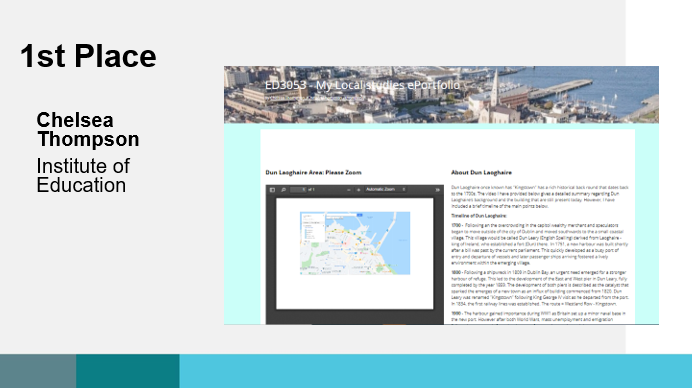
The overall winner was Chelsea Thompson, who developed her eportfolio as part of the requirements for the Bachelor of Education programme in DCU’s Institute of Education. The judges agreed that this was an all-round excellent eportfolio which surpassed the competition criteria.

Laura Furlong, also from the Institute of Education, Ore Jalaade, DCU Business School, and Lucyann Kehoe, Faculty of Humanities & Social Sciences were also recognised for their rich and innovative eportfolios.
We would like to thank all of the students who submitted entries and look forward to seeing even more creative and critically reflective examples of Loop Reflect over the next year. We would also like to acknowledge our colleague Lisa Donaldson who organised the showcase event and leads the use of and support for Loop Reflect within and across DCU.

References

Rhodes, T. (2018). Lift every voice: ePortfolios for creating and integratingInternational Journal of ePortfolio8(2), 87-89.

Exciting Next Phase of the Open Game Project…

The Open Game Project funded through the Erasmus+ programme is entering an exciting new phase as partners meet this week to plan the development and implementation of the final intellectual outputs.

In 2021, the project team, which includes several NIDL colleagues, will be offering a number of multiplier events and will be piloting and launching an innovative game designed to promote the uptake of Open Educational Resources (OERs) and Open Educational Practices (OEPs). Based on real life cases of the application of open teaching approaches, the game will provide educators with an opportunity to learn how to successfully apply OERs and OEPs in their daily practices.

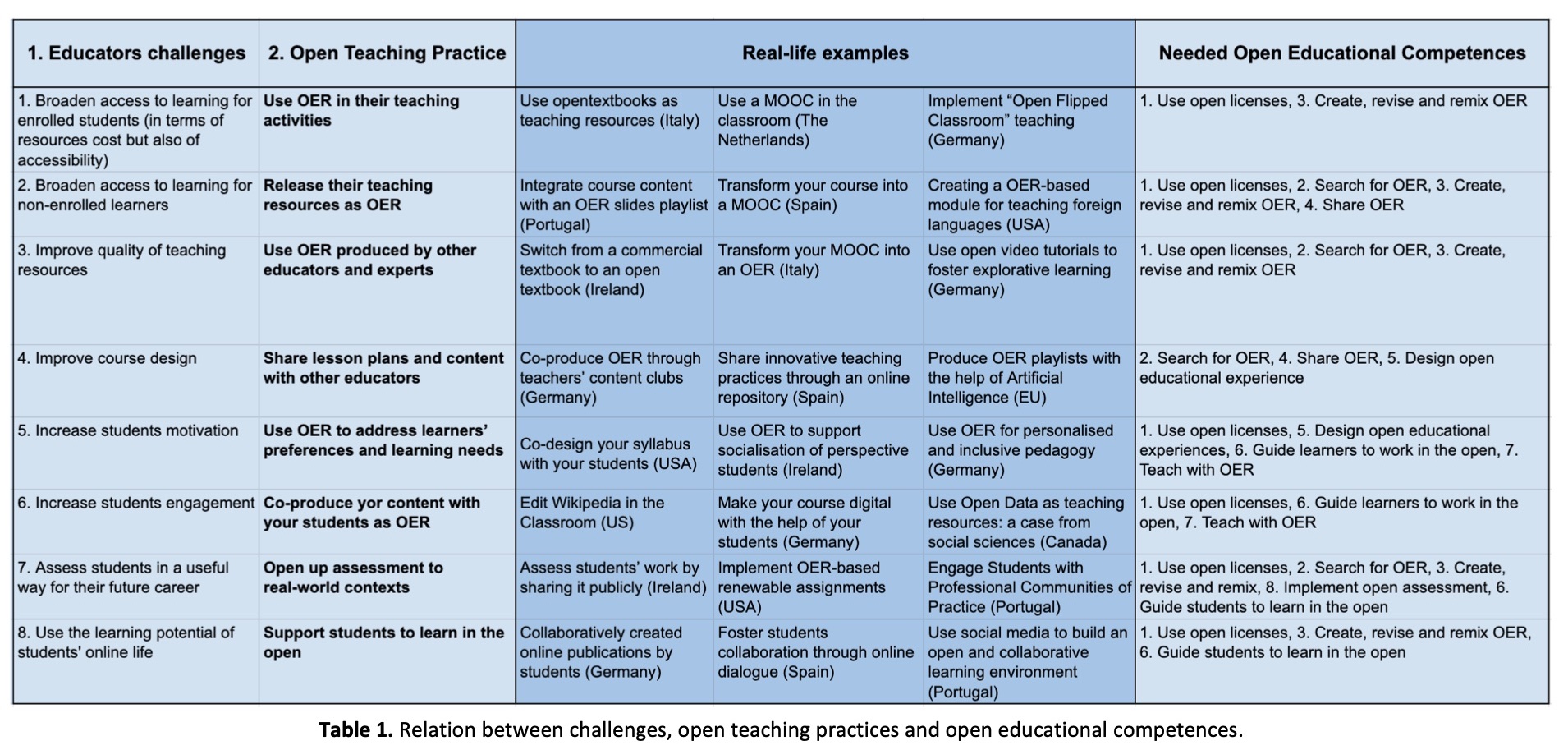
This Open Game builds on a Handbook of Successful Open Teaching Practices published in 2020 by members of the project team. As illustrated in the above table, the Handbook presents 24 real-life open teaching practices that respond to eight main challenges educators face which can be tackled through open approaches. For each of these challenges, three open teaching practices are described, with commentary on their potential for transferability and the competences needed to put them in place in other educational settings.

It is interesting to note that a recently published US report found that use of OER as required course material during the COVID crisis did not increase (Seaman & Seaman, 2021). This finding meant that based on comparative data, 2020 was the first year that growth in OER awareness among higher educators was not coupled with growth in adoption. 

As the figure below illustrates, the exception to this slight fall of uptake by all faculty was at the introductory course level. On a positive note, for the second year running a majority of responding faculty self-report at least some level of awareness of the term OER.  This result continues a trend of increasing awareness of OERs over the previous five surveys. Importantly, faculty who are aware of one or more OER initiatives were found to be much more likely to be OER adopters. This finding is a core assumption that underpin our efforts in the Open Game project to help raise the level of awareness of open teaching practices by sharing authentic real-life examples.

Another interesting finding of the US study is that perception of the value of digital materials in 2020 mirror results from the previous report, with only very slight changes. While there was considerable use of digital materials throughout 2020, it appears this has not resulted in an improvement (or decline) in faculty opinions about their effectiveness, as shown in the figure below.

Although speculative, this finding concerning the value of digital resources along with the flat growth in OER uptake provides evidence of the importance of going beyond merely raising awareness. Arguably, the real value is not the digital resource itself but rather how educators choose to embed OERs in their courses and teaching practices.

This point is another important underlying assumption of the Open Game project and why we are placing considerable emphasis on building a stronger community and sharing authentic examples of how other educators are using OERs/OEPs to address real challenges they face. As Alastair Creelman writes in a recent blog post, “Drowning in content but what we need is community”. In this respect, the Open Game project team is endeavouring to shift the focus away from OER awareness per se, to the challenges and real problems that educators may be able to resolve through their adoption, now and in the future.