In November 2019, we concluded the ICDE World Conference on Online Learning with the release of The Dublin Declaration. At the time of the World Conference, which attracted over 800 delegates from more than 80 countries, no one was predicting or even speculating on how our lives might change in the space of just a few months. Even our DCU Student Ambassadors who did a great job in assisting delegates throughout the event had no sense of how online education would become absolutely crucial to the continuation of their learning, and in some cases completion of their degrees, in the face of a global pandemic.

In the prophetic words of our conference poem:
“We no longer stop learning when the darkness gathers”.
 Since this poem was read out in such dramatic fashion during the World Conference Open Ceremony, the move to rapidly teaching online has forced many of us to think around corners and fast-track the future. A future that was not thought possible even amongst those working directly in the area. This claim is evident by a quick analysis of the collection of papers contained in the two volumes of the 2019 World Conference Proceedings:
• Proceedings of the 2019 ICDE World Conference on Online Learning, Vol 1
• Proceedings of the 2019 ICDE World Conference on Online Learning, Vol 2
In many respects, the adoption of online learning in response to the Covid-19 crisis is now an opportunity for educators to reimagine education for better futures. Accordingly, the World Conference theme of Transforming Lives and Societies is even more relevant than it was when delegates came together in Dublin. With the benefit of reflection, The Dublin Declaration (reproduced at the bottom of this post in a more accessible font) is still highly relevant to the uncertain future we are facing.

At the time, The Dublin Declaration sought to tease out and distil some of the key messages about online learning, and hopefully these will not get lost in the great onlining of education at the start of the third decade of the 21st Century. While online learning is not the panacea that will by itself transform the education system, looking towards a new and better future, traditional face-to-face delivery models can no longer be viewed as the default or baseline of good education and lifelong learning. Our discussions back in November in Dublin renewed the importance of reimagining the art of the possible and the need for growing innovative mindsets in turbulent times.
 There is a risk, however, the mainstreaming of online education will promote old 19th Century teaching methods on new 21st Century networks to merely dump large volumes of undigested information down modern digital diameter pipes to relatively passive learners, with no transformative advantage (Brown, Costello & Nic Giolla Mhichíl, 2020). Beyond the current health crisis, if we want to develop creative, innovative and highly imaginative learners capable to solving tomorrow’s problems today, then we need to value and support these dispositions in those who teach and in our future education systems.
Tensions remain, nevertheless, between traditional conceptions of education and the creation of more open cultures of innovation, which anchored in core values and practices serve to unlock the so-called “iron triangle” of widening access to learning whilst enhancing quality and reducing costs. In the post Covid-19 era, where the commercial “EdTech” sector is more prevalent than ever, questions of who is telling the online learning story, what are they telling and why, and who benefits most remain crucial to harnessing the transformative potential of digital technologies in the service of a quality education for all.
The Dublin Declaration
Set against the backdrop of Samhain, a Celtic tradition dating back thousands of years celebrating the changing of the seasons from light to dark, the 28th ICDE World Conference on Online Learning in Dublin brought together around 800 educators from 80 countries. Over five-days in November in 2019 the World Conference provided a timely opportunity to critique, critically reflect on and celebrate the many and varied facets of online education. Framed by the overarching theme of Transforming Lives and Societies, the discussions in Dublin explored competing powerful change forces and different and contrasting preferred futures for online learning. From a rich tapestry of future discourses in Dublin, the following strands help to tease out and distil some of the key messages.
-
Shifting shapes
Online education is not a neat singular shape. There are a variety of forms of online education and greater understanding is still required of the contextual and societal contours and the influence of important cultural factors in supporting learning. Moreover, the boundaries between online, open, digital and traditional models of distance learning have become increasingly blurred—for better and for worse. Therefore, online and off-line education is not a simple duality between good and bad, old and new, public and private – such binary thinking fails to convey the complexity and rapidly shifting forms of online learning and education.
-
Shades of Openness
There is a sense in which Openness is the elixir, the new gold standard of education and research. However, openness can be opaque with many different meanings and challenges. A broad spectrum critique of open is continually required, so that a myriad of education and learning futures can emerge. A renewed commitment to open practices and social justice for transformative learning experiences was asserted in Dublin.
-
Sharpening the Shoots
Talk of openness also raises controversial questions about business models. Such questions were not avoided in Dublin as the conference explored the evolving nature of the MOOC movement and the influence of commercial forces. But business models are not new and polemic debates do little to advance deeper understandings of how new models of online education might serve to unlock the so-called iron triangle of widening access to education whilst enhancing quality and reducing costs. Governments and policy-makers need to do more to fully harness the potential of online education to promote sustainable business models and implementation that support the goals of life-long learning and education for all.
-
Sunsets and Breaking Days
A key theme emerging from Dublin was that traditional face-to-face delivery models should no longer be viewed as the default or baseline of education and lifelong learning. Indeed, new and emerging models of online learning challenge conceptions of good pedagogy—irrespective of when, where and how people choose to study and learn. The continuing development of online education is impacting all delivery models and diminishing the distinction between formal, non-formal and informal learning. This point is evidenced by the strong focus in Dublin on the continued emergence of micro-credentials and their position within the landscape of recognised learning pathways.
-
Turning the Tide
Online learning is not the panacea that will by itself transform the education system. Discussions in Dublin renewed the importance of reimagining the art of the possible and the need for growing mindsets in turbulent times. A consistent theme is the hope that new online technologies will promote more transformative and considered learning experiences remains largely hype and technocentric. The conference highlighted the need for teachers, educational leaders, researchers and policy-makers to embrace and to critique current models of teaching, learning and assessment in context. Tensions remain between traditional conceptions of education and the creation of a culture of innovation. More creative, equitable and critical forms of pedagogy to redefine learning and education are required for the knowledge society and in response to the ecological crisis facing the planet.
-
Closing Chasms
The need for balance and disciplined debate to critique online education to expose the challenges, the big questions and indeed its limits were brought to the fore in Dublin. In this respect the ICDE World Conference supported rich debate, disagreement and the expression of differing viewpoints. This critique should not simply be rooted in simplistic narratives or comparisons. It requires sophisticated theoretical reasoning and empirical evidence drawn from multiple disciplines to challenge myths, misinformation and half-truths whilst adding to research and to inform transformative practice. Questions of who is telling the online learning story, what are they telling and why and who benefits most remain crucial to harnessing the transformative potential of digital technologies in the service of a quality education for all. In this respect the conversations emerging from Dublin reminds us to also ask whose story is not being told and whose voice is missing or misrepresented?
-
Rays of Light
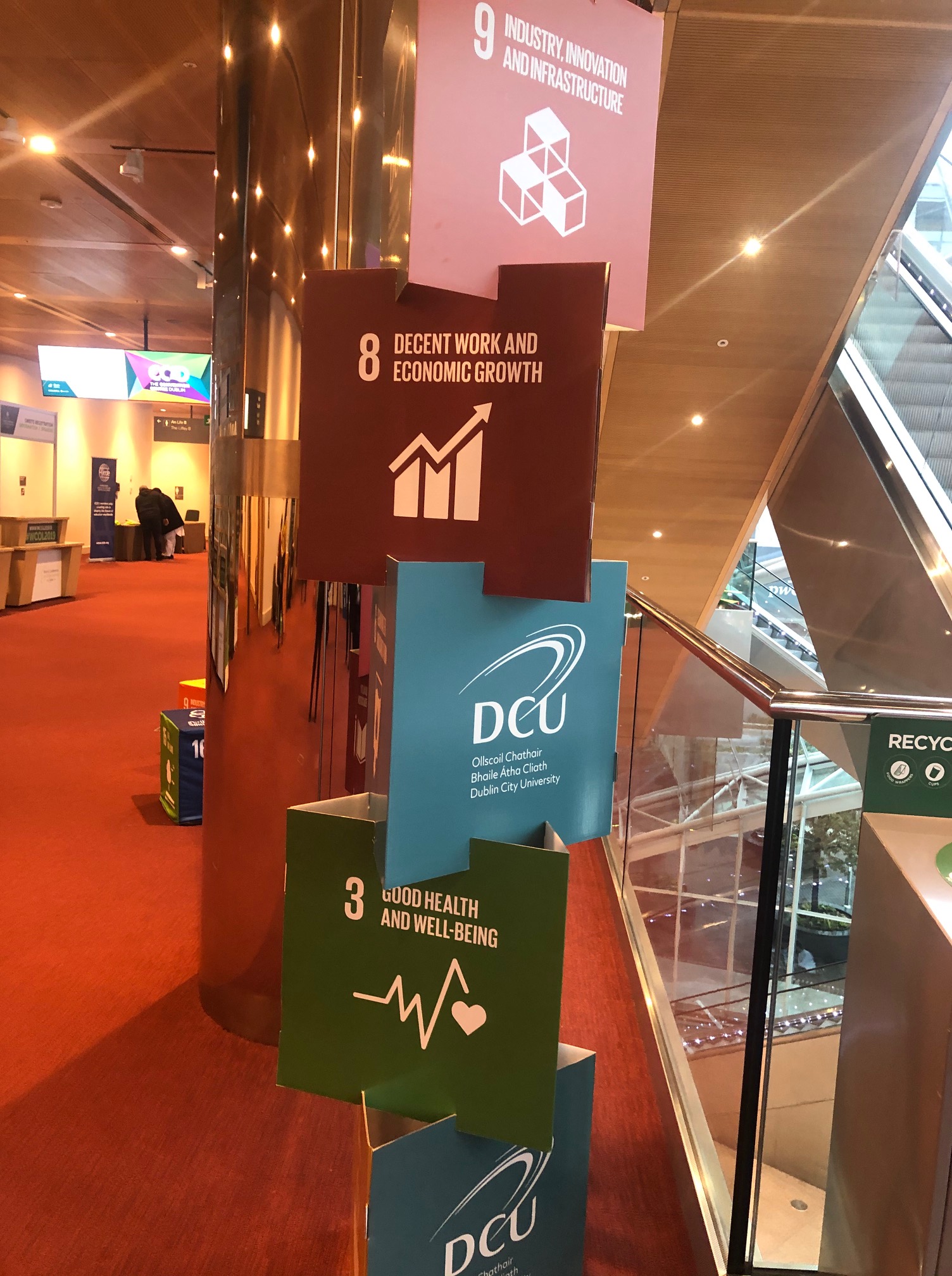
The Dublin Conference was anchored in the Sustainable Development Goals (SDGS), the conversations served to paint a bigger picture of how online education has enormous potential globally to help support and transform lives and societies. With tones and intentions of optimism, realism and activism the ICDE World Conference on Online Learning has left us with the clear message to engage with issues of social justice. It illustrated the importance and necessity of digital presence and participation of indigenous heritage and culture in the networked world to promote diversity and to support context and situated learning experiences. A rich tapestry of cultures and contexts in the online learning space connects learners and does not other their learning experiences. The concept of othering, challenged the Dublin ICDE conference to renew our commitment to access, to inclusion and to lifelong learning and to reject hegemonic monolithic thinking. Delegates leave Dublin with a clear message for the future that online learning is committed to the values and practices of social justice, equity and ethics in a cohabited, sustainable society.
Conclusion
At the heart of the ICDE World Conference in Dublin was the message of transformation. The challenge distilled by this declaration for all participants before we meet again in Natal in Brazil is to take ethical, sustainable and transformative actions that go beyond lofty aspirations.
Professor Mark Brown, Professor Mairéad Nic Giolla Mhichíl, & Professor Joe O’Hara
7th November, 2019
References
Brown, M., Costello, E., & Nic Giolla Mhichíl, M. (2020). Responding to Covid-19: The good, the bad, and the ugly of teaching online. ICDE Insider, 26th March.
Brown, M., Nic Giolla Mhichil, M., Beirne, E., & Costello, E. (eds.) (2020). Proceedings of the 2019 ICDE World Conference on Online Learning, Vol 1, Dublin City University, Dublin.
Brown, M., Nic Giolla Mhichil, M., Beirne, E., & Costello, E. (eds.) (2020). Proceedings of the 2019 ICDE World Conference on Online Learning, Vol 2, Dublin City University, Dublin.


 Digital Learning Dispatches