EMVITET aims to create new learning ecosystems for Education 4.0 in Vietnam, based on student-centered learning, competence-based education, collaboration/networking in digital environments, and sharing knowledge through a community of practice. Participants of this project will be able to:
Effectively use technology to enhance and transform teaching and learning practices
Design and implement competence-based and student-centred learning
Engage with communities within education and industry to create connections and support collaboration
The project commenced in January 2019 and the visit to Vietnam in February was the first opportunity for the European and Vietnamese partners to meet. Dr Mark Glynn and Lisa Donaldson travelled to Vietnam for the three day kickoff meeting. It was truly a collaborative experience with all partners contributing to the vision of the new pedagogical processes the project would enable. DCU will be supporting the partners to achieve a new understanding of Education 4.0 through delivering the Learning Management System portal and the eportfolio platform that will be used by participants to reflect on their learning during the three years of the project.
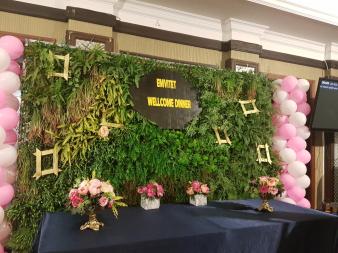
Reflecting on the first face-to-face meeting, a word has to be said about the incredible hospitality of our Vietnamese partners. The kickoff meeting was such a well planned event with valuable learning for all around culture as well as pedagogical practices. The learning was interspersed with a very festive kickoff dinner and sociable lunches. According to Lisa and Mark the Vietnamese food deserves a blog post to itself but suffice it to say they report it was delicious and plentiful!
Feedback from the first three days together was very positive and the DCU team looks forward to our next meeting in Finland in September, as we move from the preparation phase to a new vision of education for all.
I recently attended a HEA Future-focus Forum on Digital Transformation and Empowering Technologies in Higher Education. Prior to the meeting a paper was circulated setting the scene for the meeting. This contextualized the topic by referencing various Irish and EU relevant documents, including the Irish Future Jobs Initiative, the Digital Agenda for Europe, the European Digital Education Action Plan, the European Higher Education Area in 2018, etc.
The paper argued that digital transformation is pervasive and can be understood as the changes that digital technology causes or influences in all aspects of human life. In addition, Higher Education will change significantly over the coming years due to digital transformation. Critical questions include: how can higher education Institutions (HEI) provide leadership in ensuring an ethical and responsible use of technology and data? How do we empower people to build a data-first culture and future proof our digital infrastructure? What are the challenges and how do we prepare for them? What international best practice exists to inform a national approach to digital transformation in Higher Education?
The Minister for Higher Education, Mary Mitchell O’Connor, opened the meeting. She argued that digital transformation should be at the core of all Higher Education Institutions and that digital literacy is essential for all citizens. She referred to the recently launched Technology Skills 2022 Action Plan. She argued that students should be at the centre of all that we do, and that the iPhone generation are now 10 years old, whose primary communication mechanisms is through social media. However, despite the benefits of technologies, there are associated risks, such as issues around mental health and the problem of cyberbullying. New technologies are emerging all the time, such as Artificial Intelligence, robotics, Virtual and Augmented Realities. She stated that 1 in 3 jobs will be affected by digitization. Fundamentally, she argued that creativity is no longer a soft skill, it is a core skill.
Tim Fowler, Chief Executive, Tertiary Education Commission, New Zealand, focused on future proofing digital infrastructure for HE. He had three key messages: we need to be brave and be prepared to take risks and embrace change, we need to future proof and harness rich data, and we need to move towards more open practices.
Regina Murray from Microsoft Ireland pointed to some of the emergent technologies such as Artificial Intelligence, the Internet of Things, Mixed Reality, Blockchain Technologies, and Quantum Computing, She referred to the Microsoft Transformation Framework for Higher Education, which provides practical advice on how to develop a holistic digital transformation strategy. This is based on three components: teaching and learning, research and the connected campus.
Paul Doyle, from the Technological University Dublin (TUD) argued that the future is unpredictable, he referenced Gartner’s hype curve of the rise and fall of technologies. He listed five future pressures for education: digital identity and how do we know who our learners are, data transfer, the need to constantly power up and be connected, the issue of cyber-security and increasing importance of online learning. He concluded by stating we are facing a digital tsunami, with single device access.
Mary Aiken, from University College Dublin (UCD), lead the second part of the session and focused on cyberpsychology, which is the study of the impact of technology on human behaviour. She argued that whilst we are more connected than ever, young people are experiencing greater levels of anxiety, depressions and social isolation. Alarmingly she quoted that anxiety and depression has increased by 70% over the last 25 years and that around 20% of young people don’t think it is worth living.
The final session focused on providing leadership in responsible and ethical technology. This included reference to Bauman’s seminal work on liquid modernity and in particular that today’s environment is fragile, temporal, vulnerable and constantly changing. Gerald Bast, Rector of the University of Applied Arts in Vienna, argued that we need different skills, such as complex problem solving and critical thinking. He envisioned what universities in 2050 might look like. He argued that they would focus on topics rather than discipline, that lifelong learning would be central, that MOOCs and open access would be prominent, that emergent technologies such as Artificial Intelligence and Augmented Reality would be important, that there would be new roles for teachers, that curricula would be personalized and that students would collaborate rather than compete.
The proceedings and presentations from the event will be available on the HEA website in the coming weeks. Overall, it was a valuable day with lots of thought-provoking issues raised. Many of these issues will be explored further at this year’s ICDE World Conference on Online that Dublin City University (DCU) is hosting in the Convention Centre in early November.


 EMVITET aims to create new learning ecosystems for Education 4.0 in Vietnam, based on student-centered learning, competence-based education, collaboration/networking in digital environments, and sharing knowledge through a community of practice. Participants of this project will be able to:
 The project commenced in January 2019 and the visit to Vietnam in February was the first opportunity for the European and Vietnamese partners to meet. Dr Mark Glynn and Lisa Donaldson travelled to Vietnam for the three day kickoff meeting. It was truly a collaborative experience with all partners contributing to the vision of the new pedagogical processes the project would enable. DCU will be supporting the partners to achieve a new understanding of Education 4.0 through delivering the Learning Management System portal and the eportfolio platform that will be used by participants to reflect on their learning during the three years of the project.
 The kickoff meeting was such a well planned event with valuable learning for all around culture as well as pedagogical practices. The learning was interspersed with a very festive kickoff dinner and sociable lunches. According to Lisa and Mark the Vietnamese food deserves a blog post to itself but suffice it to say they report it was delicious and plentiful!
 The paper argued that digital transformation is pervasive and can be understood as the changes that digital technology causes or influences in all aspects of human life. In addition, Higher Education will change significantly over the coming years due to digital transformation. Critical questions include: how can higher education Institutions (HEI) provide leadership in ensuring an ethical and responsible use of technology and data? How do we empower people to build a data-first culture and future proof our digital infrastructure? What are the challenges and how do we prepare for them? What international best practice exists to inform a national approach to digital transformation in Higher Education?


 Digital Learning Dispatches