
By Dr Orna Farrell
On the 20th of April, I gave a presentation at a webinar organised by European Distance and Elearning Network (EDEN) about how to design and manage assessments for online learning which was part of a webinar series called Education in Time of a Pandemic. The webinar contributors included Prof. Mark Brown from DCU’s National Institute for Digital Learning, Dr. Lisa Marie Blaschke from the University of Oldenburg and Dr. Alfredo Soeiro from the University of Porto. I started my presentation with a quotation from Winston Churchill:
“Out of intense complexities, intense simplicities emerge”.
I felt this quote was appropriate for the current educational context because although it is a very uncertain time, there could be potential to reimagine our approaches to assessment. For example, we could take this opportunity to clear out some of the deadwood or kill a few sacred cows in the educational system. The sacred cow I focused on was the campus-based examination system.

In the literature on assessment, exams are considered to be a poor measure of student learning which emphasizes knowledge reproduction rather than critical thinking. For example:
“they tend to measure lower order thinking skills in a decontextualized manner at a time when the literature frequently argues for the benefits of a richer, authentic approach to assessment” (Villarroel, Boud, Bloxham, Bruna, 2020, p. 38)
If the literature indicates that richer authentic approaches to assessment can benefit student learning, why are higher education institutions so attached to exams? Face-to-face campus-based exams are surrounded by ritual, bureaucracy and awe in higher education. I think we should take advantage of the opportunity that the pivot online created by the Coronavirus pandemic and kill the sacred cow of closed book campus based exams permanently.
Replicating campus-based exams online through timed proctored online exams is not the solution. In her recent presentation at #Gastagoesglobal, Sheila McNeill talked about how online proctored exams promote a culture of distrust and surveillance and how we should instead be creating a culture of support, trust and development for our students.
Student Engagement and Covid-19
When designing alternative emergency assessments for our students we need to think about student engagement in the context of Covid-19 pandemic. Adapting Kahu’s (2013) model of student engagement to encompass the Covid19 pandemic context is a useful lens to help us understand how our students can engage and learn successfully during this crisis.

Important factors that we should consider are lifeload, course and assessment design, access to adequate broadband and computing equipment, the availability and accessibility of institutional remote online supports. Kahu (2013, p. 767) describes lifeload as “the sum of all the pressures a student has in their life, including university”, and is seen as being a critical factor influencing student engagement. Everyone including students and staff are experiencing increased lifeload pressures due to the pandemic, such as illness, caring responsibilities, home schooling, and remote working. Time management and organisational skills are key skills for student success (Farrell & Brunton, 2020). In addition, students are experiencing difficulties with broadband, access to computers, finding quiet study space and sufficient time to study. These pressures are impacting on our students well-being, their time, and their ability to learn successfully.
Our Approach to Crisis Assessment
In Dublin City University (DCU), the institution identified four key principles for crisis assessment:
-
Validity
-
Equivalence
-
Proportionality
-
Academic Integrity
These principles were applied across the University coupled with coupled advice for choosing alternative assessments to adapt exams into more appropriate alternative assessments. In our DCU Connected Humanities programmes, for example, which are modular online degrees we applied these four principles and adapted our exams into openbook take home assessments. Openbook take home assessments adhered to these principles and were a flexible, low bandwidth asynchronous assessment approach.
Alternative Assessment Ideas
In the webinar, we discussed a number of alternative assessment ideas, such as:
-
-
Eportfolio
-
Collaborative wiki
-
Asynchronous online debate
-
Vlog
-
Blog
-
Podcast
-
Online presentation
-
Asynchronous group project-Gdocs
-
Video creation
-
Reflective journal
-
Peer assessment
-
My colleagues from the NIDL, Suzanne Stone and Rob Lowney have created an edited open access resource called Exemplars and Case Studies of Technology Enhanced Assessment in HE and FE which has more details on these alternative assessment ideas. For more resources on alternative assessment and the pivot online, check out the NIDL Teaching Online Resource Bank.
Academic Integrity
The issue of academic integrity came up frequently in the discussion at the webinar. Our approach to academic integrity involves creative design of authentic assessment, moderation of marking, text matching software, clear guidelines to students about our expectations around referencing and the use of vivas to verify student academic work. These are detailed further in the resource below, and our Academic Integrity Self-Assessment Checklist.
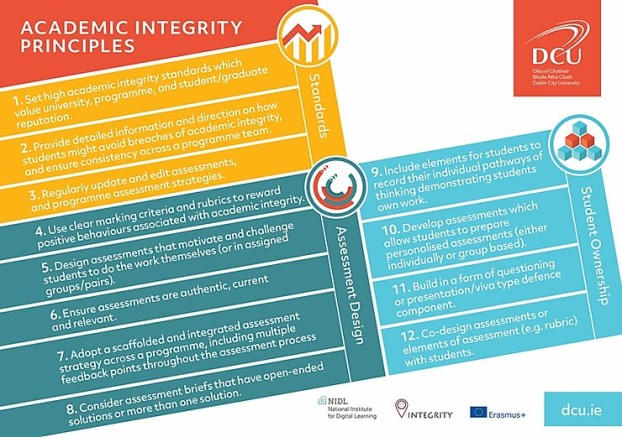
DCU (2018) Academic Integrity Principles
Final thoughts
In these unprecedented times, it is important that we support the well-being of our students, while addressing the need to have quality assessment. In the context of student engagement and Covid-19, using low bandwidth, flexible and asynchronous assessments may enable our students to succeed at completing their studies and #keeplearning.
References
DCU Teaching Enhancement Unit (2018). Academic Integrity Principles. Retrieved from Academic Integrity for Quality Teaching and Learning in Higher Education (INTEGRITY Project): https://teuintegrityproject.wordpress.com/
EDEN Webinar resources and recording https://www.eden-online.org/how-to-design-and-manage-assessments-for-online-learning/
Farrell, O. (2020) “Out of intense complexities, intense simplicities emerge.”: Assessment and the pivot online. Presentation at EDEN NAP Webinar.
Farrell, O., Brunton, J. (2020). A balancing act: a window into online student engagement experiences. Int J Educ Technol High Educ 17, 25. https://doi.org/10.1186/s41239-020-00199-x
Kahu, E. R. (2013). Framing student engagement in higher education. Studies in Higher Education, 38(5), 758–773. https://doi.org/10.1080/03075079.2011.598505.
NIDL Resource bank https://www.dcu.ie/nidl/resources/Swiftly-Moving-Online-Coronavirus.shtml#Assessment
Villarroel, V., Boud, D., Bloxham, S., Bruna, D., & Bruna, C. (2020;2019). Using principles of authentic assessment to redesign written examinations and tests. Innovations in Education and Teaching International, 57(1), 38-49. doi:10.1080/14703297.2018.1564882
Stone, S. Lowney, R. (2020). Exemplars and Case Studies of Technology Enhanced Assessment in HE and FE
Note: This blog post originally appeared as a guest commentary on this Portuguese site established to support teaching online in response to the Covid-19 crisis.

 An AdvanceHE Fellowship demonstrates a personal and institutional commitment to professionalism in learning and teaching in higher education. Across
 Digital Learning Dispatches