Five Lessons from Learning in the Light: Reflecting on the Onlining of Irish Higher Education

By Mark Brown

Speaking from Washington DC on the morning of Thursday 12th March 2020 the Irish Taoiseach (Prime Minister), Leo Varadkar, announced that all schools and higher education campuses across Ireland were to close at 6:00pm. This news was not totally unexpected, but the short notice caught many people by surprise and resulted in a flurry of activity within and across Irish educational institutions.

0

The campus and school lockdown quickly evolved to other sectors with the Government introducing new regulations requiring all bars, restaurants and shops to close. At the time of writing, Ireland remains in a tight lockdown situation until current restrictions are reviewed on May 18th, 2020. However, there is every indication that social distancing requirements will continue for the foreseeable future and seriously impact the start of the new academic year.

No alt text provided for this imageWhen Dublin City University (DCU) hosted the ICDE World Conference on Online Learning back in November 2019 no one amongst the 800+ delegates from over 80 countries could have predicted the great onlining of Irish higher education in the weeks and now months since the Taoiseach’s announcement. The pivot to rapidly teach online has forced us to think around corners and fast-track the future (Brown, 2020). While history teaches us to be wary about making speculative claims about the future it is highly probable that online education will never be the same again (Brown, Costello & Nic Giolla Mhichil, 2020). In 2012, the New York Times declared it was the “Year of the MOOC” (Pappano, 2012) and now 2020 is likely to be known as the year when online education helped us to keep teaching and keep learning. With the benefit of hindsight there is a prophetic quality that rings remarkably true to this extract from Learning in the Light, a poem written by Réaltán Ní Leannáin for last year’s World Conference:

“We no longer stop learning when the darkness gathers,

Those old webs have crumbled in this era of light.

In an age of information, learning squats tight in our grasp, within reach of all.”

On the whole the Irish response to emergency teaching online in the face of darkness and incredibly challenging circumstances has been remarkably positive and relatively successful. The period from March 2020 to May 2020 can be described in three phases:

(i) get online quickly,

(ii) get organised to develop appropriate alternative assessments, and

(iii) get thinking about future scenarios and next steps.

While the Irish story of our response to the Covid-19 pandemic is still being written the unprecedented pivot to online learning will be etched forever into the history of higher education (Brown, 2020). As we pause, look to the future and enter a new stage, however, what lessons can we learn from the experience so far? Although the following reflections and five lessons drawing on the experiences of the NIDL team do not claim to be a definitive or representative account of how Ireland has responded to the Covid-19 global pandemic, hopefully they contribute to useful learnings and further conversations as we move forward.

You can read the five lessons and the rest of this blog post on Mark’s personal Linkedin account.
A Planful Move to Teaching Online: Useful Resources for Educators

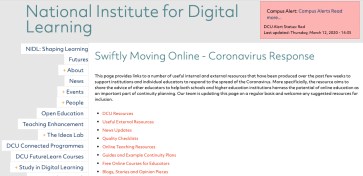
A wealth of useful guides, resources and blog posts for moving to online teaching in a more planful manner have been produced over the past few days. A great effort by many educators! We have been trying to keep up and keep track of many of these resources by reading, reviewing and listing them on a new “Swiftly Moving Online” NIDL webpage. Hopefully this compilation of resources will help more people to become aware of the many helpful tips, ideas and suggestions available to educators to plan and successfully pivot to online teaching and learning.

Swiftly.jpg

Understandably, our NIDL team at Dublin City University (DCU) was busy last week preparing for the potential scenario of having restricted campus access. Accordingly, we offered several online professional development workshops for staff using Zoom and refreshed and/or updated many of our previous online teaching resources. We have included links to some of these resources at the start of this new page to provide examples of what one institution is doing in response to the current crisis, although more specific staff and student guides appear in Loop — our VLE.

photo-1521175776577-f8e0c1e5ecb7As previously announced, we will be offering a webinar for educators new to online teaching on Monday 16th March at 12 noon (GMT) in partnership with the European Association for Distance Teaching Universities (EADTU).
Our
#OpenTeach team will also be offering a free online course starting on Monday 23rd March as part of an Irish National Forum funded project. We have also produced a Padlet wall to help collate and share top tips for teaching online, which we hope other educators will contribute to over the next few days. 

NIDL Virus.jpg

In terms of the list of external resources, we hope some of the quality checklists are helpful with the team at Quality Matters in the U.S. having produced emergency online teaching guides for both schools and those who teach in higher education institutions. In Ireland, the National Forum has shared a Google doc which contains a list of community sourced resources for Irish educators. Also, in Ireland, the Professional Development Service for Teachers (PDST) has also been quick to respond to the current situation by adding a special Distance Learning page for schools to their website.

Our own list of general teaching online resources contains more than 25 links to a range of tips, toolkits and takeaway guides from around the world. One weakness which we hope to address is the current limited number of guides and resources for students new to online learning. By the middle of last week, DCU quickly prepared a “Keep Learning” guide for students and also reminded people about our suite of free online courses in Discover DCU along with our “Who Can I Ask?” tool for online learners who may be in need of wider support.  We are also pleased to be able to offer our 24/7 online study coach and assignment writing service through Studiosity to our DCU Connected learners and targeted campus-based students.

IMG_6710.JPG

Additionally, we share a number of more specific guides and examples of business and academic continuity plans from various sources. Moreover, the resource includes a growing number of free online courses available to educators on the topic of online teaching, including two normally restricted courses opened up by Epigeum and an EdX course on Pivoting to Online Teaching which starts on Wednesday 18th March.

Lastly, this resource bank lists a number of blogs, news stories and opinion pieces related to the so-called “Great Onlining of 2020”, which we reported in a previous blog post some commentators describe as a black swan. Time will tell what the current crisis means for the long-term future of education but many people agree that “online learning” has changed forever. Mindful of this claim, our team aims to keep updating the webpage with additional resources as time permits and as they are published over the next few days and weeks. In the meantime, we trust this a useful resource and contribution at such a difficult and challenging time.