
This year we were delighted to continue our strategic partnership with the Education Studies Association of Ireland (EASI) to support another Digital Learning Research Symposium as part of the annual conference in Cork (20-22 April, 2017). The conference theme was “Changing Research: Working the Spaces between Education Policy and Practice”.

The Research Symposium was designed in accordance with this theme to explore a number of big questions confronting researchers in the area of digital learning. It built on ‘The Next Generation Digital Learning Research Symposium’ jointly hosted by ESAI in November 2016 at Dublin City University (DCU) in partnership with the Irish Learning Technology Association (ILTA) and National Institute for Digital Learning (NIDL). The intention of this follow up event was to discuss some of the contemporary issues, opportunities and challenges facing the field with a critical eye on the future. More specifically the Symposium was structured to explore the following questions:
- What research in the area of Digital Learning is currently being conducted in the Irish context?
- How is the Openness movement reshaping the nature of formal education?
- What are the implications of the Unbundling movement for the future of formal education?
- What are some of the issues and challenges arising from the emergence of analytics and big data in formal education?
- What is the role and potential of coding in the school curriculum?
In exploring these questions, the aim was to critically reflect on the impact of the digital era on formal education set against the context of wider societal changes—for better and worse. Additionally the above framing questions were designed to help participants identify, discuss and debate some of the current gaps in the literature as digital learning continues to evolve nationally and internationally.
The opening slide-deck setting the background to the symposium appears below along with one of the presentations on the issue of unbundling of higher education.
 This innovative project, first of its kind in Europe, was framed by Dublin City University’s (DCU) mission of ‘transforming lives and societies’ and strongly anchored in five core principles of ethical leadership: inclusion, openness, collaboration, sustainability and transformation for better futures. The objective was to canvas the community for ideas using an innovative online platform during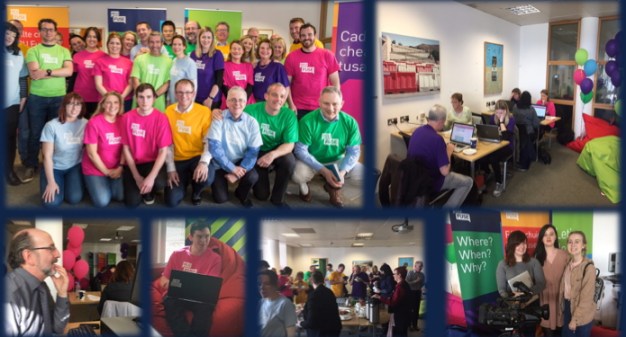

 Digital Learning Dispatches