Calling all higher education educators in Ireland, Europe and globally… how have you been feeling while teaching online? We need your help as a team of NIDL researchers would like to better understand educators’ affective experiences of teaching online in response to the COVID-19 global pandemic to learn valuable lessons and help inform support strategies moving forward.
Accordingly, we would really value your participation in this research that has full ethical approval. We are aware that everyone is extremely busy at the moment but understanding educators’ experiences during these challenging times is more important than ever as we plan for the upcoming semester and beyond. Therefore, please have your say by sharing your insights and valuable experiences through our anonymous survey.
You can read more about this research and complete the online survey after giving your informed consent by clicking on these links. Also we would really appreciate it if you could share this message with your colleagues or post a link to the survey through social media in order to spread the word.
Even before the current COVID-19 health crisis, “blended learning” was one of the most discussed and researched teaching approaches or modalities in higher education. As Charles Dziuban, Peter Shea and Patsy Moskal (2020) write in a recent article appearing in Educause Review:
“Greater reliance on blended learning may be what a post-COVID-19 higher education landscape will turn to for a variety of reasons, so a better conceptual understanding is much needed (P.1).”
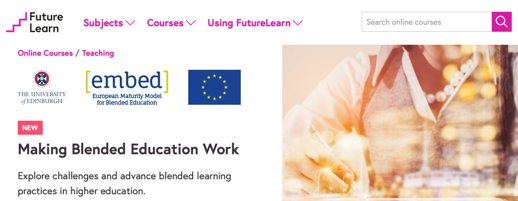
So what is blended learning? How is blended learning best facilitated in higher education? Why does blended learning matter? How can we advance blended learning practices? What is the future of blended learning? If you are looking for answers to these questions, the upcoming course “Making Blended Education Work” on the FutureLearn platform might be for you.
This free online course developed as part of the EMBED project is designed for people involved in leading the design, implementation and research into blended learning in higher education. It covers topics relevant to institutional leaders, learning technologists, practitioners, and researchers who are interested in blended learning related research and implementation strategy. The course, which the NIDL was pleased to co-author with our EMBED partners, starts through FutureLearn on 11th May.
One of the first questions we explore in Week 1 is the thorny issue of the definition of blended learning. There are many variations on the concept of blended learning at different ends of a definitional spectrum, and in this respect the course makes an important distinction between blended learning, blended teaching and blended education. By the time participants get to the final week of the course they will have an opportunity to critically reflect on some of the different perspectives and underlying assumptions of the Blended Education Maturity Model, as we challenge educators to question the future of blended learning in a post-digital world. This discussion will be facilitated by Mark Brown and Mairead Nic Giolla Mhichil from the NIDL where they will also ask how might blended learning take on a different face or new significance in the post COVID-19 era?
Whether the course is able to fully answer these questions will depend on your own perspective. As Dziuban, Shea and Moskal (2020) conclude:
“Perhaps blended learning is best considered an evolving process. Instructors change their blends during a semester, or from year to year, depending on several factors. One semester the blend works well—the next semester, much less effectively. So how does one answer the question, “Does blended learning work?” The question creates a recurring problem because of blended learning’s complexity and emergent properties where the whole is more than the sum of its parts” (P.17).

 Calling all higher education educators in Ireland, Europe and globally… how have you been feeling while teaching online? We need your help as a team of NIDL researchers would like to better understand educators’ affective experiences of teaching online in response to the COVID-19 global pandemic to learn valuable lessons and help inform support strategies moving forward.
 By the time participants get to the final week of the course they will have an opportunity to critically reflect on some of the different perspectives and underlying assumptions of the Blended Education Maturity Model, as we challenge educators to question the future of blended learning in a post-digital world. This discussion will be facilitated by Mark Brown and Mairead Nic Giolla Mhichil from the NIDL where they will also ask how might blended learning take on a different face or new significance in the post COVID-19 era?
 Digital Learning Dispatches