
By Clare Gormley, Rob Lowney & Suzanne Stone
When a group of us were first introduced to the ABC Learning Design (ABC LD) framework through a study visit to University College London (UCL) in 2017, we were intrigued by the accessibility and potential of the approach. What’s not to like about a workshop that promises a pedagogically robust (re)design of a course in under 2 hours, all while collaborating with colleagues and considering new ideas?
Becoming partners in the transnational ABC to VLE Erasmus+ project gave us the opportunity to apply this approach at DCU and further develop the method while learning from our European partners. As a result the team in the Teaching Enhancement Unit (TEU) have facilitated ABC workshops in multiple contexts within DCU and as part of invited seminars and conferences.
So far we have run and evaluated 20+ ABC sessions, working with teams of staff to use the framework to rethink the student learning experience on their courses.
This work with ABC has significantly evolved from on-campus to online so in this blog post, building on the spirit of knowledge exchange emerging from the ABC Swap Shop series, we would like to explain what we have done and share some lessons learned along the way.
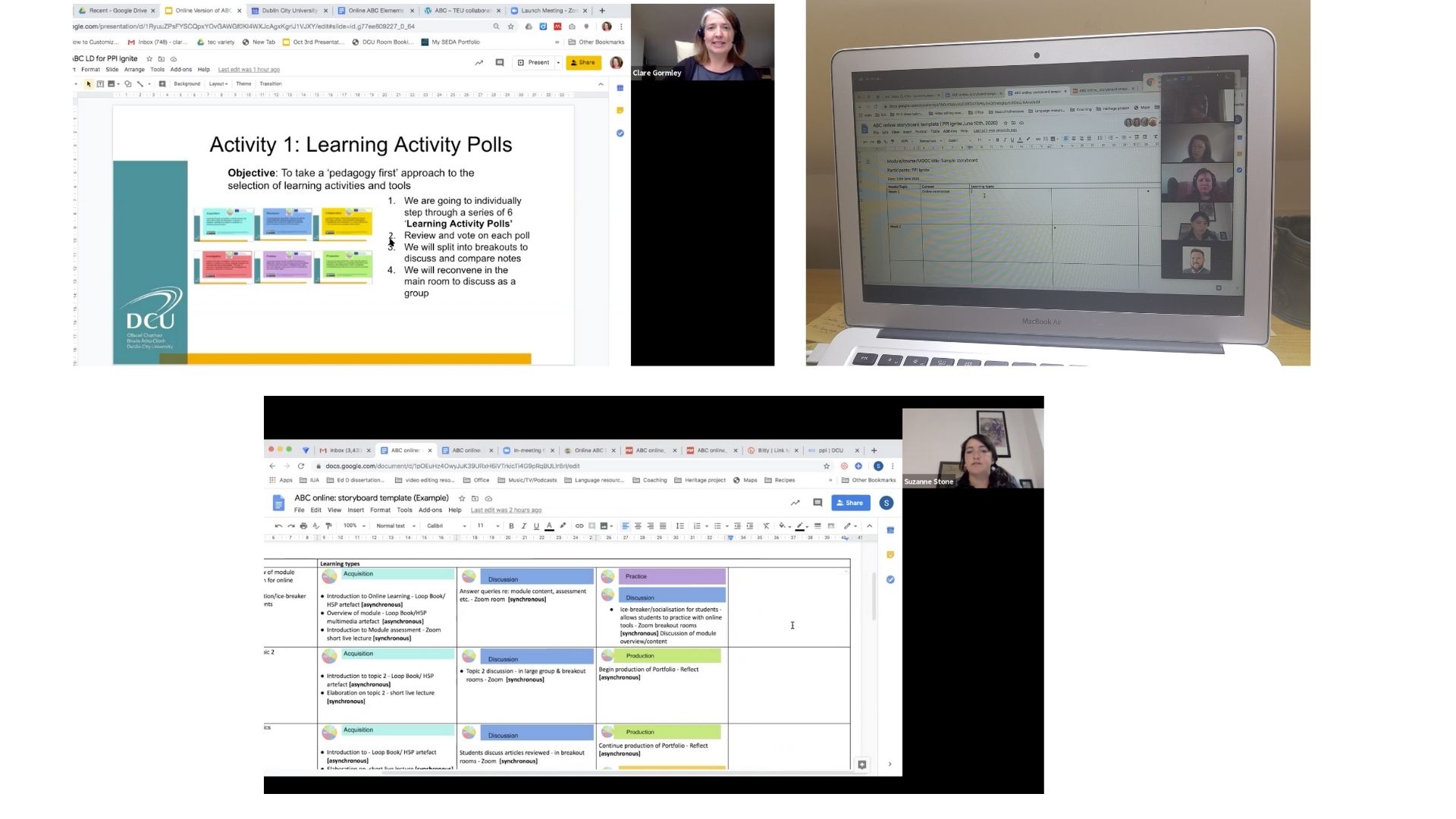
Our challenge was to move from this original in-person version….

To this purely digital ABC approach, designed for staff at DCU…
The starting point
As the Covid crisis continued it became clear that for an extended period of time most DCU staff would continue to work remotely and rely on Zoom Meetings to collaborate with colleagues. It was not realistic to pause our offerings of ABC workshops during this period so therefore we started planning what an online ABC workshop could look like. The in-person workshop covers a lot (tweet, graphs, learning types and more) in a remarkably short space of time. Our first challenge was to decide what realistically we could achieve in an online format, noting that “things online take more time”.
The first iteration of the online workshop took place in May 2020. It started with a brief description of what ABC LD method is followed by overview of session activities and then a quick discussion of existing module learning outcomes. Then we introduced the six learning activity types, giving participants 3 minutes to independently read each card before being split into breakout rooms to discuss further. Spokespeople were appointed and the plan was to document discussions (via shared Google Doc), proceed with storyboarding, and wrap up with an action plan that would capture next steps.
Although we were broadly happy with this first run at an online ABC workshop, we did feel that improvements could be made.
The early part of the workshop saw participants working quietly alone, to make notes on the learning types. Participants were then placed into breakout rooms to discuss only some of the learning types before coming back to the main room. We felt the division of learning types for the breakout activity might have placed a constraint on the discussion. Similarly, only one spokesperson from each breakout room was invited to populate the Google document, which might have left others feeling left out or unable to contribute as they would like. We therefore wanted to figure out a way to maximise participation and began to think about how the use of polls might encourage everyone to input in a time-efficient and democratic way.
A second major refinement of the workshop was our approach to kick-starting the storyboarding process. In the face-to-face context, storyboarding can be scaffolded very directly by physically prompting participants to engage with the storyboarding resources. This was less easy in the online mode of delivery and resulted in a very slow start to storyboarding. We felt that this hesitation indicated a less clear understanding of the process and so devised a new approach. A video was developed to introduce this stage and explain how one might storyboard a module using a couple of examples.
We continued to refine the approach after each subsequent workshop as we learned more about what worked well and what did not. Feedback from participants after workshops helped inform this, as did our own reflections. Furthermore, as staff were preparing to teach mostly online for the upcoming academic year we wanted to model good practice and looked at the affordances of local technologies to support the ABC workshop.
After several refinements, by the end of summer 2020 our online ABC workshop looked like this:
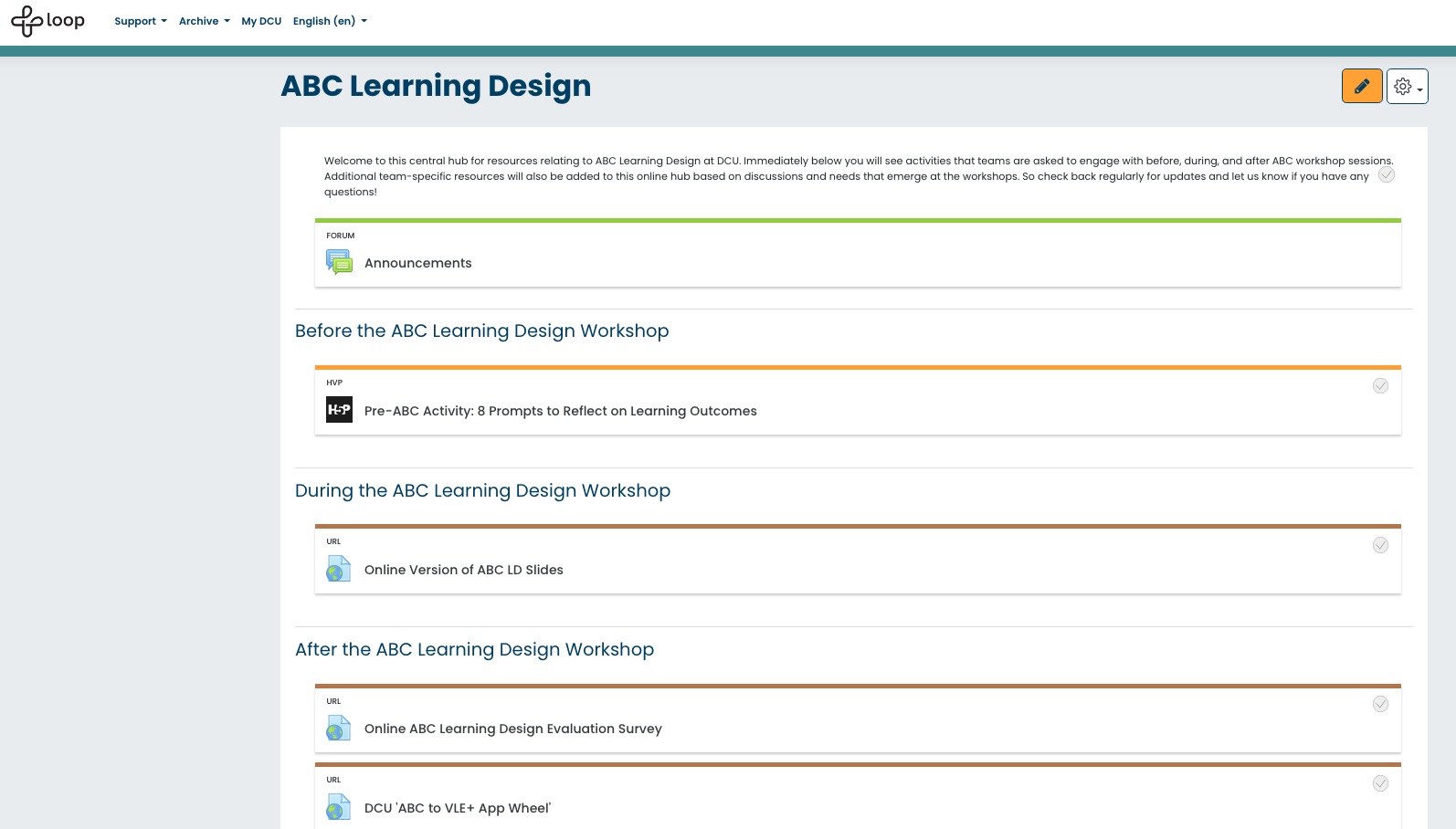
- Before the workshop, participants are asked to engage in an asynchronous Pre-ABC workshop activity called ‘8 Prompts to Reflect on Learning Outcomes’ to focus minds on the end-goal of their design and prepare for the workshop. This is an H5P interactive object available on our dedicated Loop (Moodle) course for ABC workshop participants.
- At the start of the 2 hour live workshop which is run in Zoom, introductions are made and expectations set. A short video ‘Top 6 Activities for Hybrid Learning’ is also played, to give participants who may not be familiar with VLE tools and terminology a sense of some possibilities.
- The six learning types are introduced one by one and a short explanation given of each. The sample learning activities for each type are presented as Zoom polls and participants choose the types that they feel are most relevant to the module in question.
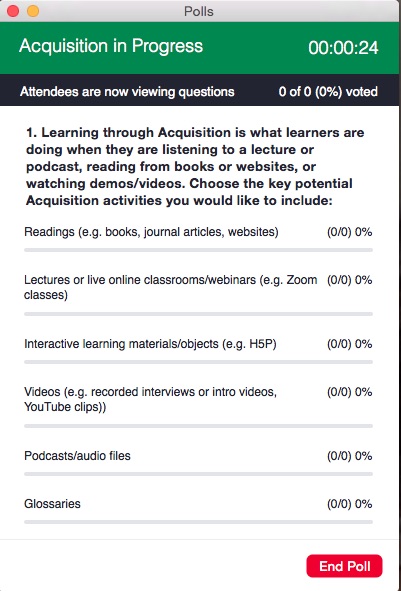
- Participants are then divided into breakout rooms with a facilitator each to answer the question “How might the activities suggested so far enable your students to achieve the desired learning outcomes?”. The participants discuss the results of the polls and the types they feel are most relevant. This helps move the group towards a consensus.
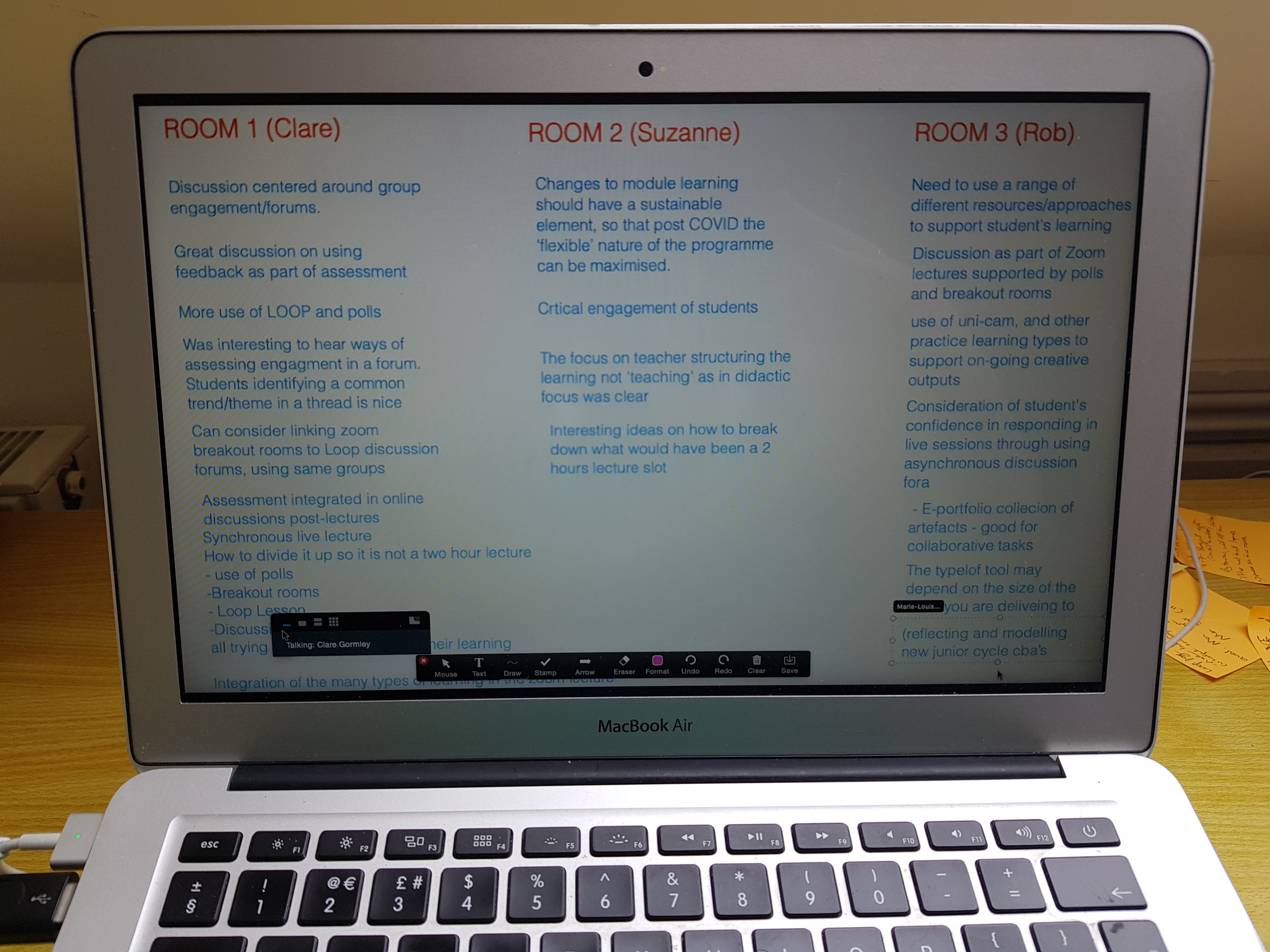
- Upon returning to the main room, participants are asked to annotate a Zoom whiteboard and add the main points of discussion and prevailing learning activities discussed in the breakout room. As the whiteboard grows, commonalities between the breakout rooms become evident and the most appropriate learning activities are identified. The whiteboard is saved and shared afterwards as a reference resource.
- Participants are next shown a video explaining what storyboarding is and how to go about storyboarding a module using the language and tools of ABC LD. There is time to discuss the storyboarding process and then a storyboard template in the form of a shared Google document is circulated via the chat. Participants are invited to remain online and commence storyboarding while the facilitators depart or the team can decide to storyboard at another time themselves.

- To assist with implementation of proposed designs, follow up resources including the DCU ABC to VLE+ App Wheel are forwarded to staff after workshops. These are shared on our in-house ABC hub along with curated guidance on key supports (e.g. online resources and workshops) available at DCU relevant to workshop discussions.
So how has it gone down with staff?
Initial evaluations of the ABC workshops to date have been very positive from both formal evaluations and informal follow-up discussion. The combination of using polls to introduce the learning types, followed by discussion in the breakout rooms was mentioned by several respondents as the most useful aspect of the workshop. The storyboard process and video were also mentioned explicitly as positive aspects. An unexpected outcome was that participants considered the workshop approach a positive model of online delivery, evident in the following comment:
The session offered a useful overview of tools and approaches and the structured activities offered an effective demonstration of how these could be used and sequenced.
The potential impact beyond the current focus of learning design for one single module/academic year is also evident in the comment below:
The alignment of my module LO’s to the different learning strategies was presented in a very practical and informative way to allow me to be more creative in my lecture delivery as a whole, not solely in the current year.
Some suggestions for improvement include the request for more case studies highlighting in particular the balance of synchronous and asynchronous learning activities for an online module. The need for more time for various activities was another suggestion which came very strongly from the evaluations to date. This is a particular challenge to address as the fast-paced approach is a central appeal of the ABC Learning Design approach. However the team are considering an ‘opt-in’ version of the workshop where participants stay online (e.g. 30 minutes longer) in order to make more progress on the storyboarding stage with facilitator support.
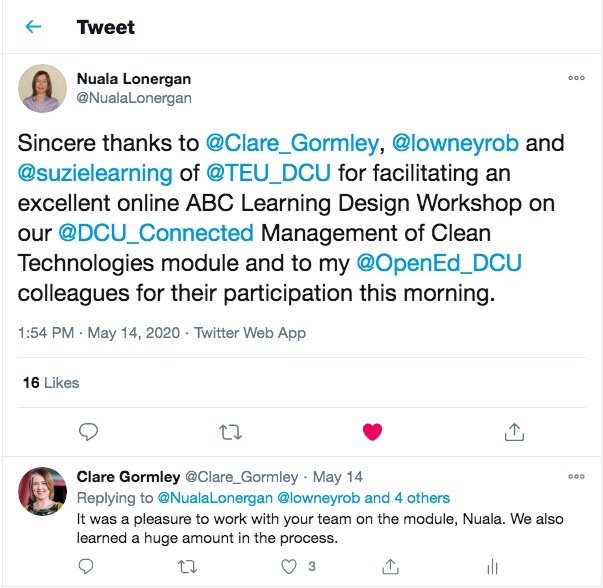
We have also received feedback from participants via email and Twitter and include a selection below.
Feedback from Dr Anna Logan, Associate Dean for Teaching and Learning DCU Institute of Education
I’m delighted to see this level of interest in the ABC learning design approach which apart from the immediate impact in this emergency context can only be beneficial for programmes in the medium and longer term…there has been great reach of ABC across a range of our programmes which is super.
Email feedback from Dr Jane O’Kelly, Chair of BSc in Education and Training, DCU:
Thanks Clare, Rob and Suzanne for the training this morning. I really enjoyed it and have had great feedback from the team on it. All found it really valuable and felt inspired to tackle the work needed for this semester. Part-time lecturers enjoyed the chance to discuss approaches with the team and I think full-time lecturers found something new to reinvigorate them!!! Thanks again, really practical, interesting support and tools that will make a difference in our planning.
Where to next?
ABC has become a core learning design framework at DCU for the design of new programmes and for those changing to a fully online or more hybrid and/or blended format. Future plans will address feedback raised by workshop participants. Very importantly, since we recognise that immediate feedback is only part of the evaluation picture, we will go back to participants in six months time (and beyond) to learn more about the outcomes of the workshop. This way we hope to find out what specific changes occurred in practice so we can continue to enhance the format and our knowledge of how best to apply it. If you would like to hear more about our experience of implementing ABC to learning design, then please don’t hesitate to contact us.


 Digital Learning Dispatches