
Three New Online Professional Learning Courses for Educators

On Thursday 18th of November, the official DigiTeL Pro launch took place. This collaborative European funded project began earlier in the year with the aim of bringing together a team of experts from several universities, well-known for their research and leading-edge innovation in digital education.

A major feature of the launch was an overview of three new online professional learning courses designed for higher educators. Each course, listed below, explores a different mode or dimension of digital education. Together they aim to support European educators to build their teaching skills and professional capabilities for digital education relevant to their particular interests and institutional contexts.

Course 1: Synchronous and Hybrid Education

Learn more about the course, view a brief presentation and complete the registration form

Course 2: Blending Your Education

Learn more about the course, view a brief presentation and complete the registration form

Course 3: Online Education

Learn more about the course, view a brief presentation and complete the registration for

We invite you to register for these course and/or to share relevant details within your professional networks.
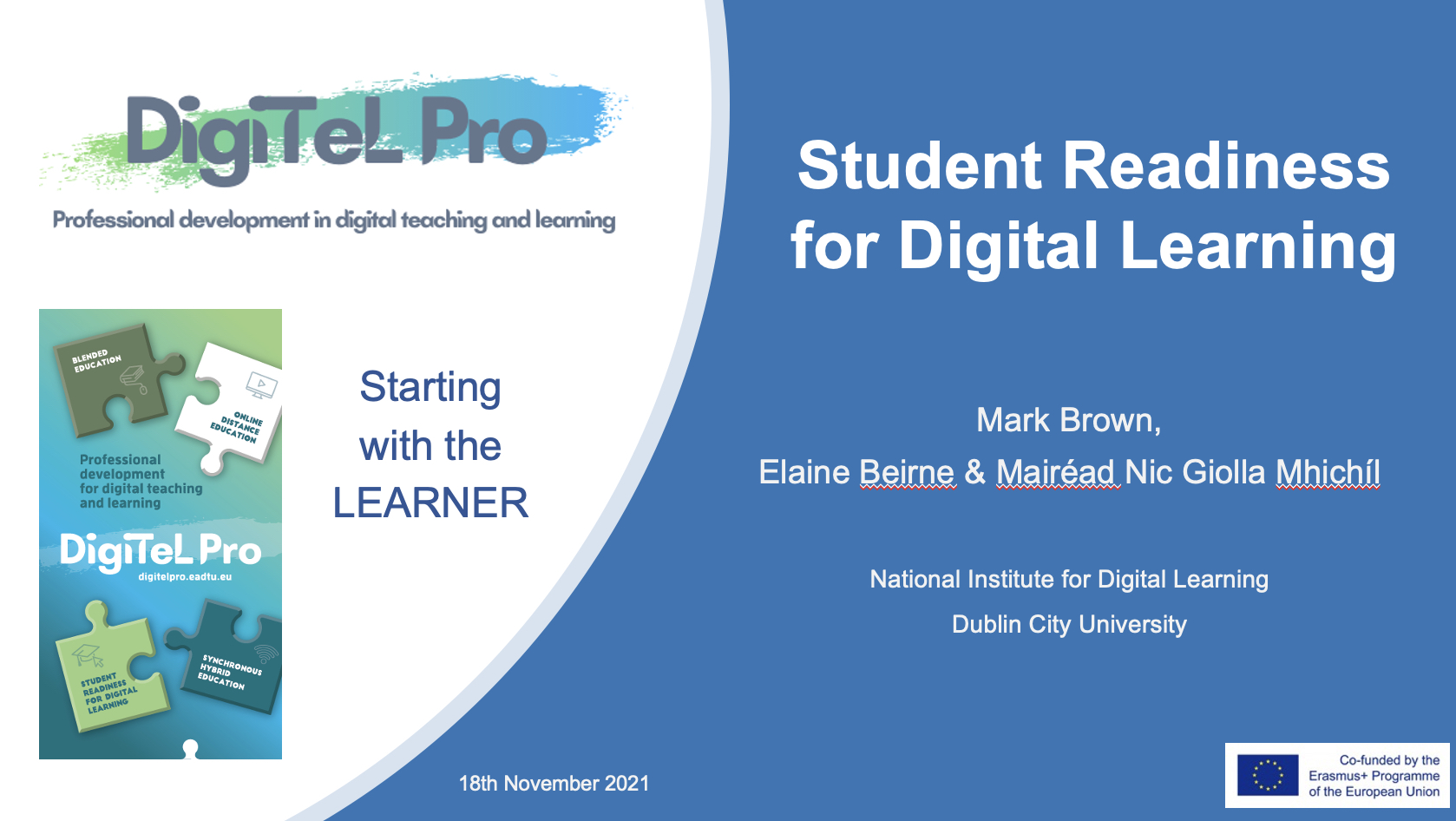
As part of the DigiTeL Pro launch event, we also provided a brief update on DCU’s free course, A Digital Edge: Essentials for the Online Learner, offered through FutureLearn. This course, co-facilitated by students and originally supported by IUA and the DCU Students’ Union, has so far attracted over 10,000 students worldwide with a completion rate of over 50%. Over 2,000 DCU students have claimed full certificates of completion. The course was a direct response to the COVID crisis and focuses on developing student readiness for online learning. It completes the suite of offerings supported by DigiTeL Pro.
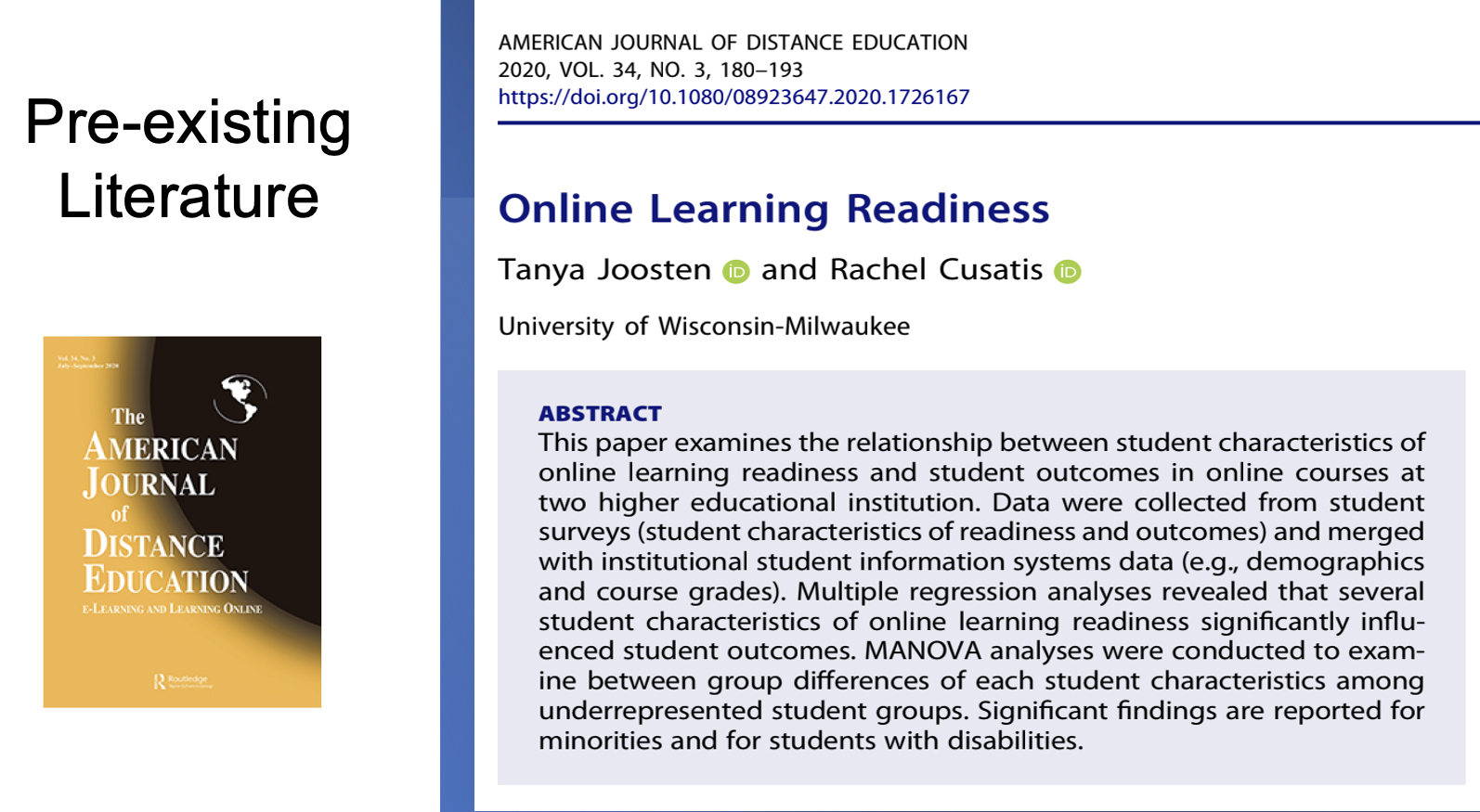
To further infuse a strong student readiness dimension across and throughout all four courses, the NIDL team has undertaken a literature review to help answer the following questions:

  1. What research has been published reporting student readiness for online distance learning during the COVID crisis?
  2. How strong is the “learner voice” in COVID-related research reporting on student readiness for online distance learning?
  3. What lessons can be taken from the COVID-related literature on student readiness for new models of digital education?

A report of this research will be published in the New Year, but we can already conclude from our analysis that there is limited evidence of previous literature on student readiness informing the COVID response. Secondly, although numerous national and institutional surveys have been published over the past 18 months, which report on the COVID experience, the vast majority of this research does not adequately convey the student voice. Hence, this suggests that, with a handful of exceptions, an important gap remains in the literature which tells the students’ lived experience in their own words.

The above video provides a full recording of the DigiTeL Pro launch event. We look forward to sharing further information in 2022 on this project which is being led by the European Association of Distance Teaching Universities (EADTU).

What are the Main Trends in Online Learning? A Helicopter Analysis of Possible Futures

By Mark Brown

While the COVID-19 pandemic has been a game-changer for online learning on several levels, the field has a long and rich history. This history has not always featured in our response to the pandemic. Earlier in the year, I was asked to undertake for an external organisation a helicopter analysis of the main trends in online learning with an eye on the future, but anchored in this history. What follows in this blog post is a raw version of my analysis that has yet to find its way into a formally published paper. The intention of this post is to share some of my analysis and the related thinking arising from both the research and the more popular literature before we start another potentially memorable year in the evolution of online learning. The analysis identifies five macro-level trends: 

  • Convergence
  • Massification
  • Openness
  • Interactivity
  • Diversification 
Photo by Casey Horner on Unsplash

The Definition Problem

Before setting out to consider major trends in Online Learning, it does help to set some parameters for the analysis or at the very least to establish from the outset that defining the field is a challenge. Online learning is far more complex than usually understood in everyday language and practice. According to Singh and Thurman (2019), the term “Online Learning” was first used in 1995 in the early development of the Learning Management System (LMS), which in Europe is better known as the Virtual Learning Environment (VLE). Since then, online learning has evolved and is a term whose meaning has become less clear over time (Irvine, 2020). As Irvine (2020) observes, 

“What used to be a simple binary of face-to-face or online has now become so extremely complex that our ability to understand each other is impaired” (p. 42).

The semantics have been muddied as online learning is often spoken about in the context of many overlapping terms such as e-learning, blended learning, digital learning, distance learning, flipped learning, hybrid learning, to name a few. Therefore, as mentioned above, defining online learning for this analysis was not a straightforward task, with Singh and Thurman (2019) identifying 46 definitions in their recent literature review. Notably, common features of most definitions include but are not limited to concepts of time, space, distance, interactivity and use of technology, particularly the Internet. While physical distance is not always an element for defining online learning, it is mentioned consistently. For this reason, the following discussion frames the analysis of current trends in online learning around the following definition:

“Online learning is defined as education being delivered or experienced in an online environment either synchronously or asynchronously through the use of the Internet where learners do not need to be co-present in a physical space” (adapted from Singh & Thurman, 2019). 

A wealth of literature falling under this broad definition has been published over the past 25-years. Importantly, a great deal is already known about the effective design of synchronous and asynchronous online learning environments, as reported in several major literature reviews (e.g. Means, et al., 2010; Siemens, Gasevic & Dawson, 2015; Martin, Sun & Westine, 2020). There is a body of scholarly literature exploring major trends and patterns in online learning in a similar vein. For example, the annual Horizon Report (EDUCAUSE, 2021) and Innovating Pedagogy Report (Kukulska-Hulme, et al., 2021) help to identify past, present, and future trends. There are also efforts to retrospectively analyse trends such as Bozkurt and Zawacki-Richter’s (2021) interesting visual representation of the online (distance) learning landscape. More popular opinion pieces on future trends and speculative scholarly works looking into the future also make up the literature, which collectively informs this analysis. 

Photo by Diego Jimenez on Unsplash

The remainder of this paper outlines five macro-level trends in the evolution and potential future development of online learning. Set against the background of these trends, how we choose to shape, reshape and reimagine the future ways that online learning can be deployed in the service of education, lifelong learning and the type of [digital] societies we want to create is a very different matter. This is a much bigger question that needs to frame any discussion of our possible, probable and preferred futures.

Go to Mark’s LinkedIn page to read the full text of this future trends analysis.