
The National Institute for Digital Learning (NIDL) values the opportunity it has to actively contribute to promoting innovation in teaching and learning through Dublin City University’s membership of the European Consortium for Innovative Universities (ECIU). The ECIU has a collective mission of ‘challenging conventional thinking’ through a collective emphasis on promoting innovation, creativity and societal impact, driving the development of a knowledge-based economy.

A week or so ago members of the Steering Committee for Innovation in Teaching and Learning, chaired by Professor Mark Brown, met in Copenhagen to review a range of activities over 2017 and plan a number of new initiatives for the year ahead. This meeting took place at Aalborg University alongside the annual meeting of ECIU Rectors and Presidents and therefore brought together some of the leading and most influential innovators in European higher education.
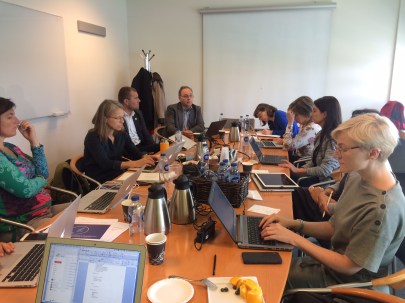
The Steering Committee supports activities ranging from regular masterclasses, leadership initiatives, exchanges for sharing of innovative practice, awards for innovations in teaching and learning, and scholarly activities which promote a strong nexus between research and teaching. With a common focus on fostering innovation the following teaching and learning statement encapsulates the shared understanding of ECIU members:
“We believe that teaching in higher education really matters. Therefore, our members share a commitment to the development of high quality educational practices which promote innovation and the pursuit of excellence in teaching and learning. As ECIU partners, we value a strong nexus between research and teaching in order to fulfill such a vision. We strive to provide a modern, engaging and research-intensive learning environment, which builds on the diversity and collective strength of our respective institutional cultures, our approaches to teaching, and our students.
The ECIU has a specific interest in seeking out creative, learning-centred and future-focused teaching approaches that foster social entrepreneurship and smart use of technology. We aspire to create the conditions for developing critical responsible citizenship for inclusive and diverse societies. Our members foster real world competencies and make this possible by engaging our students with industry, professional bodies and community partners.
In summary, the ECIU represents a leading international cluster of technological and comprehensive universities who are committed to a bold mission of “Challenging Conventional Thinking” for tomorrow’s world, today.”

In late November 2017, the annual Team Award for Innovation in Teaching and Learning will be presented in Brussels. Importantly, this award recognises that most successful and sustainable innovations involve a team of educators working towards a common goal. In 2018, the Steering Committee also plans to host a special ECIU event once again in Brussels to explore the future of teaching and learning in the wider context of the modernisation of European universities. Accordingly, it follows that our own NIDL team looks forward to contributing to this event as supporting new models of digital learning and teaching is likely to feature prominently in the programme.
 It was developed by Professor Mark Brown and Fred de Vries with the aim of supporting the needs of both experienced and new and emerging institutional leaders responsible for a variety of open, online and flexible learning initiatives in higher education. Previously Mark has contributed as a faculty member to the Institute for Emerging Leaders in Online Learning offered by the Online Learning Consortium in the United States as well as a similar programme in Australia.

 The programme is designed to promote strategic thinking in the context of a number of wicked problems facing higher education and explore future scenarios for preferred new and emerging models of teaching and learning. As the two different EOLLA programmes offered this year demonstrate there are benefits of working with a single institution but equally when participants can learn from each other across institutions.
 Digital Learning Dispatches