

On Monday, our masterclass on Higher Education 4.0 in partnership with the new ECIU University began with the aim of raising critical awareness, fostering rich discussion and getting participants from around the globe to think about this overarching big question:
What will Higher Education look like by the year 2030?
To set the scene, we invited participants to watch this brief video produced in 2019 by Jisc. The video was framed by the point that we need to be critical about who is defining the future for us.
While we cannot predict the future drawing on the video we asked, will the future of universities be shaped in an inclusive way or left to men already in positions of power and responsibility in established institutions in well-developed countries? This question, which the video illustrates is a very real concern, established our intention in the masterclass from the outset to promote debate, contestation, and reshaping of higher education from a wide variety of critical perspectives.
Future Skills Agenda
Over this first week, our main focus has been on what we have called the future skills agenda set against the backdrop of Industry 4.0. A core challenge facing higher educational institutions is how they respond to major societal developments, including the changing nature of work. We began this discussion by exploring the popular claim that 65% of jobs of the future have yet to be invented? Indeed, The Institute for the Future (2017) goes even further in a report which says
“…that around 85% of the jobs that today’s learners will be doing in 2030 haven’t been invented yet” (p.14).
Our poll result in response to this question showed a spread of opinions across participants.

Demise of the Ice Traders
To place speculative talk concerning the future of jobs in an historical context, we shared an interesting example on the demise of the ice industry.
Did you know that just over a century ago harvesting and selling ice was a massive industry employing thousands (if not millions) of people?
It involved an extensive supply chain around the world and in the second half of the 19th Century some people got very rich harvesting and selling ice.
But in a matter of only a few short years, the whole industry collapsed with almost everyone losing their jobs. How come? The invention and widespread uptake of mechanical refrigeration removed the reliance on natural ice, although it did take 30+ years and the widespread availability of electricity for the full impact of the invention of the refrigerator to become apparent.
Changing Nature of Knowledge
This line of discussion gets us thinking about the currency of the day. Drawing on the work of our colleague Prof. Ulf-Daniels Ehler (2020) in his recent online book on future skills, we explored how the nature of knowledge is changing. To quote (Ehler, 2020):
Knowledge is no longer being thought of as something that is developed and stored in the minds of students, experts, represented in books, and classified into disciplines. Instead, it becomes more and more apparent that knowledge is now seen more as a fluent, energy-like system of networks and flows. Knowledge is defined – and valued – not for what it is, but for what it can help to do (p.14).
You can listen to Ulf talking more about how the evolving definition of knowledge and the nature of future skills in this video from a talk given during last year’s EDEN webinar series in Open Education Week.
Traversing the Transversal
An important feature of Week 1 is a focus on transversal skills and competencies (or what some people call soft skills) and we discussed some of the challenges of defining and measuring these skills. The importance of future mindsets rather than narrow skillsets has been a common theme in the discussion posts. However, our example from the opening Jisc video reminds us to be wary of which mindsets are being valued over others and whose voice is missing from efforts to reshape the future. Here we identified the role of indigenous worldview and First Nation perspectives.
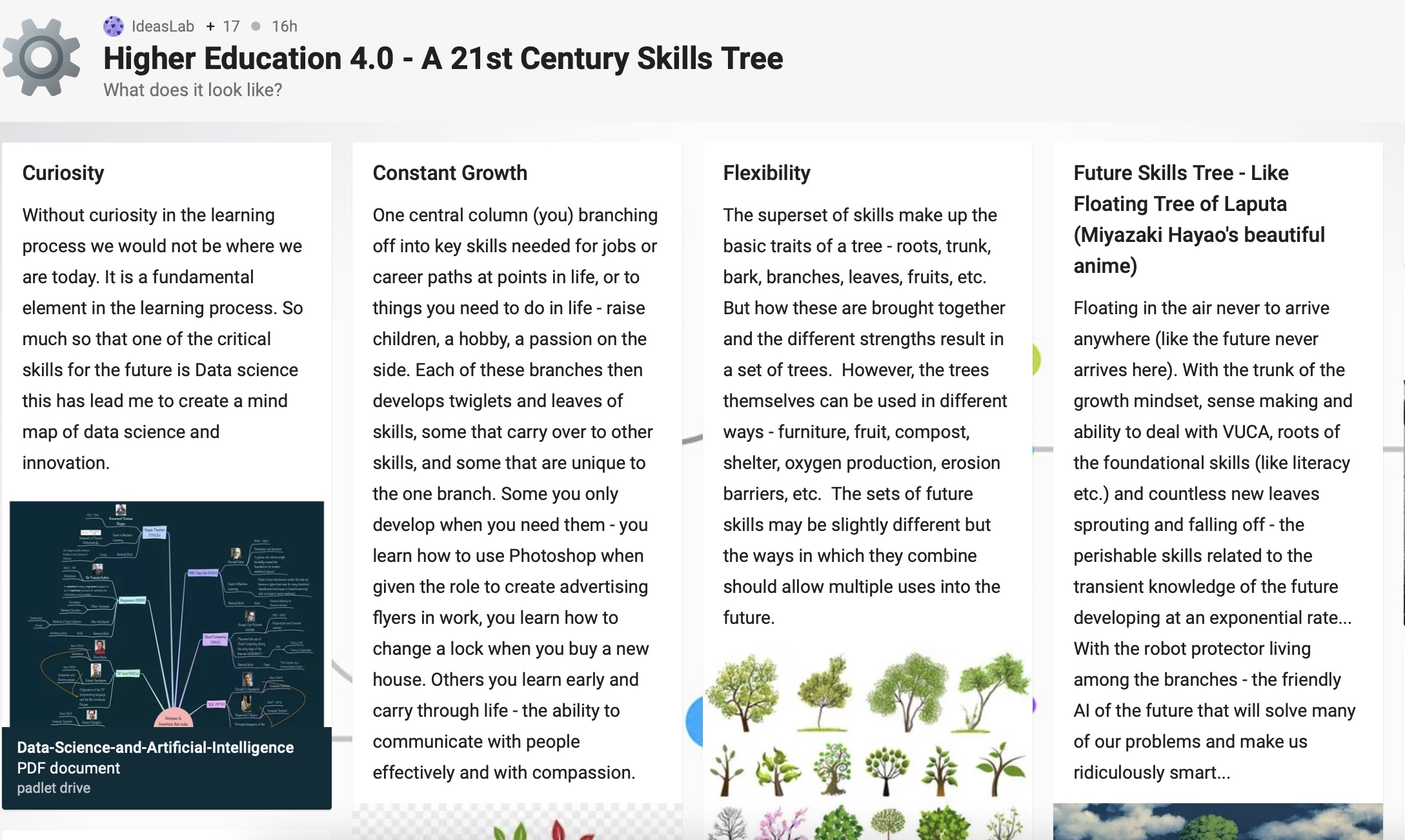
One of the activities for participants was trying to metaphorically map these future skills, with some rich offerings on our Padlet wall, as illustrated below.
As we come to the end of Week 1, participants are currently responding to a scenario related to the often cited 21st Century skill of “Global Citizenship”. They have been appointed in this scenario to a committee at their institution, and given a simple mission – to come up with a series of criteria for i) defining, ii) operationalising, and iii) assessing this future skill. No easy task!
Looking Ahead
While throughout the week we have debated the true significance of the changes taking place in response to Industry 4.0, and how we might need to redefine future skills, it is difficult to imagine that higher education will be unaffected by powerful change forces, including the pandemic.
Next week, we shift our attention to how traditional credentials might become an increasing focus of attention over the next few years as traditional higher education institutions respond to the future skills agenda. We spend most of next week discussing the rise and the rise of micro-credentials and what impact they are likely to have over the next 5-years.
It’s not too late to join this discussion as we seek to raise greater awareness of many competing change drivers and help fellow educators, and other related stakeholders, (re)envision the future of higher education by 2030. We hope to talk with some of you online next week.


 Digital Learning Dispatches