
The Empower Online Learning Leadership Academy (EOLLA) is a unique and challenging professional development programme. 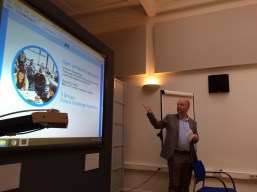 It was developed by Professor Mark Brown and Fred de Vries with the aim of supporting the needs of both experienced and new and emerging institutional leaders responsible for a variety of open, online and flexible learning initiatives in higher education. Previously Mark has contributed as a faculty member to the Institute for Emerging Leaders in Online Learning offered by the Online Learning Consortium in the United States as well as a similar programme in Australia.

The first EOLLA programme was launched last year in a partnership between the European Association of Distance Teaching Universities (EADTU) and the European Consortium for Innovative Universities (ECIU). In 2017, EOLLA has been offered at the end of May to a cohort of 15 participants who met in Brussels at the end of May and more recently to a group of more than 20 staff at the Hellenic Open University in Patras, Greece.

During the two-day programme, which usually begins with an online primer, participants have an opportunity to share experiences and learn from a number of authentic case studies intended to reveal both the challenges and opportunities of leading in an era of change.  The programme is designed to promote strategic thinking in the context of a number of wicked problems facing higher education and explore future scenarios for preferred new and emerging models of teaching and learning. As the two different EOLLA programmes offered this year demonstrate there are benefits of working with a single institution but equally when participants can learn from each other across institutions.
A brief presentation about EOLLA appears in the following slide-deck, which was presented at in May 2017 a visionary leadership summit at UNESCO’s Headquarters in Paris.
 This innovative project, first of its kind in Europe, was framed by Dublin City University’s (DCU) mission of ‘transforming lives and societies’ and strongly anchored in five core principles of ethical leadership: inclusion, openness, collaboration, sustainability and transformation for better futures. The objective was to canvas the community for ideas using an innovative online platform during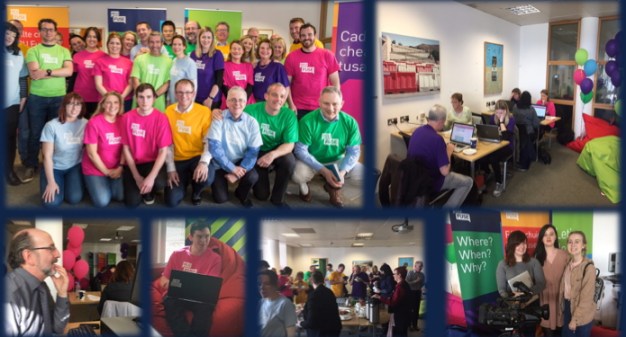

 Digital Learning Dispatches