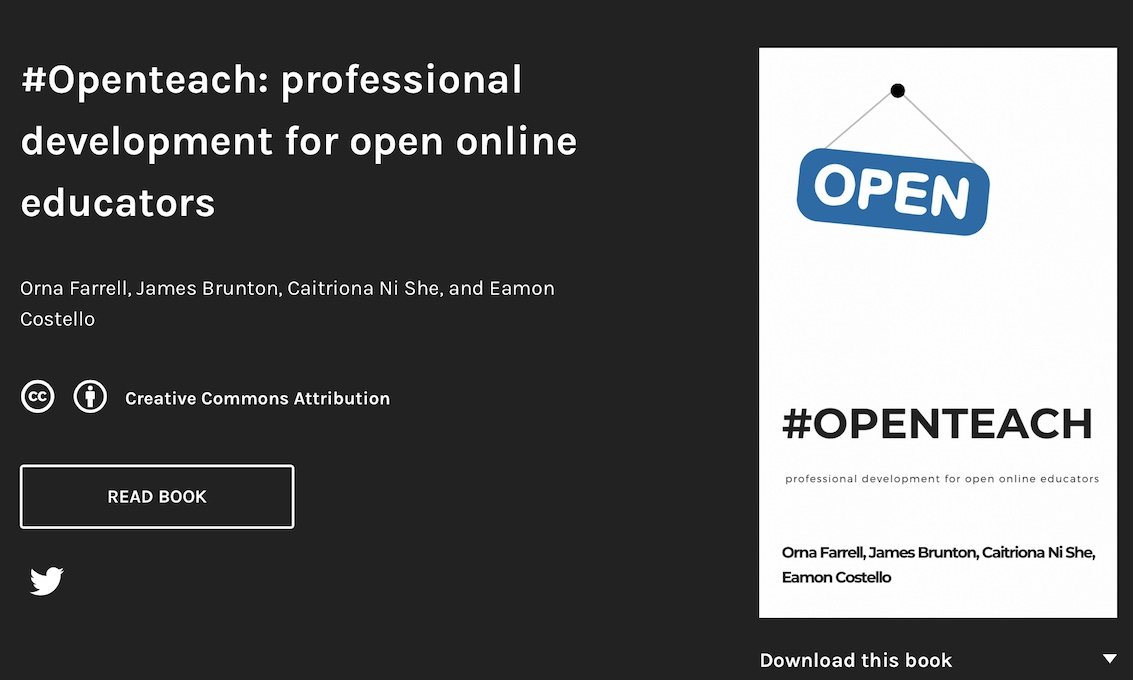
In this book we aim to share the knowledge, resources and research generated by the #Openteach project, which aimed to create an evidence-based and open professional learning approach to support educators to teach online.
Teaching online is different, in this book we explore this difference with the aim of supporting educators to develop their online teaching practice and knowledge of online pedagogy.
The book combines the theory and practice of teaching online and contains examples and ideas, drawn from the voices of online educators and online students. We consider key themes in online pedagogy such as presence, interaction, supporting online students, and synchronous and asynchronous engagement.
Why an open book?
#Openteach: Professional Development for Open Online Educators is an open online book published on the Pressbooks platform. The book is further evidence of our commitment to open access publishing through a Creative Commons License (CCL). The principle of openness was at the heart of the #Openteach project. All of the resources and intellectual outputs were CCL and openly shared through social media and the project website. The #Openteach online course was freely available and participation was open to anyone, from anywhere, with the capability to join an online course.
Over a year into the COVID-19 pandemic, with Zoom now at the heart of our new ‘remote’ lives, it is easy to forget that in March 2020, online teaching and learning was a brand new experience for many staff and students. With little time for planning, the initial pivot to remote teaching and learning was very much an emergency response and far from what we would aspire to in terms of online teaching and learning design. As April and May unfolded, it became clear that the emergency pivot online would continue into the new academic year.
This extended period offered the DCU community an opportunity to move past emergency remote teaching and learning provision, and to conceptualize the student learning experience for the online space in a more considered manner.
While the pedagogical redesign of learning activities continued to be undertaken in an emergency context, there was a little more time to consider the needs of both students and staff. Conversations were happening at local and National level around how best to address these needs as we moved into a second semester of remote teaching and learning.
Against the background of such conversations, a funding call from the DCU Educational Trust, sparked an idea for a potential research study for Ann Marie Farrell, Lecturer in the School of Special and Inclusive Education.
Having a wealth of experience and expertise in large cohort teaching and learning, Ann Marie was particularly concerned about the implications of the emergency pivot to remote teaching and learning for students and staff in such contexts.
The invitation to get involved in the project was a ‘no-brainer’ for the Teaching Enhancement Unit (TEU) contingent (*Karen Buckley, Mark Glynn, Rob Lowney and Suzanne Stone). As the Unit planned for a second semester supporting staff around remote teaching and learning, insights on the particular challenges of the large cohort context would be invaluable. Seán Smyth (4th year Bachelor of Education student) completed our research team, adding an incisive student perspective
Meeting the Challenge
Having successfully secured funding for the research project, reality struck! The prospect of fitting an additional piece of work into our schedules at such a demanding time was frankly terrifying.
It was important to the team that the research would offer practical support for DCU staff as we moved into the next academic year, adding the additional challenge of a short timeframe.
Despite these challenges the project structure took shape and the collaborative and supportive team environment enabled the work to progress at the required pace. The purpose of the study was determined as follows:
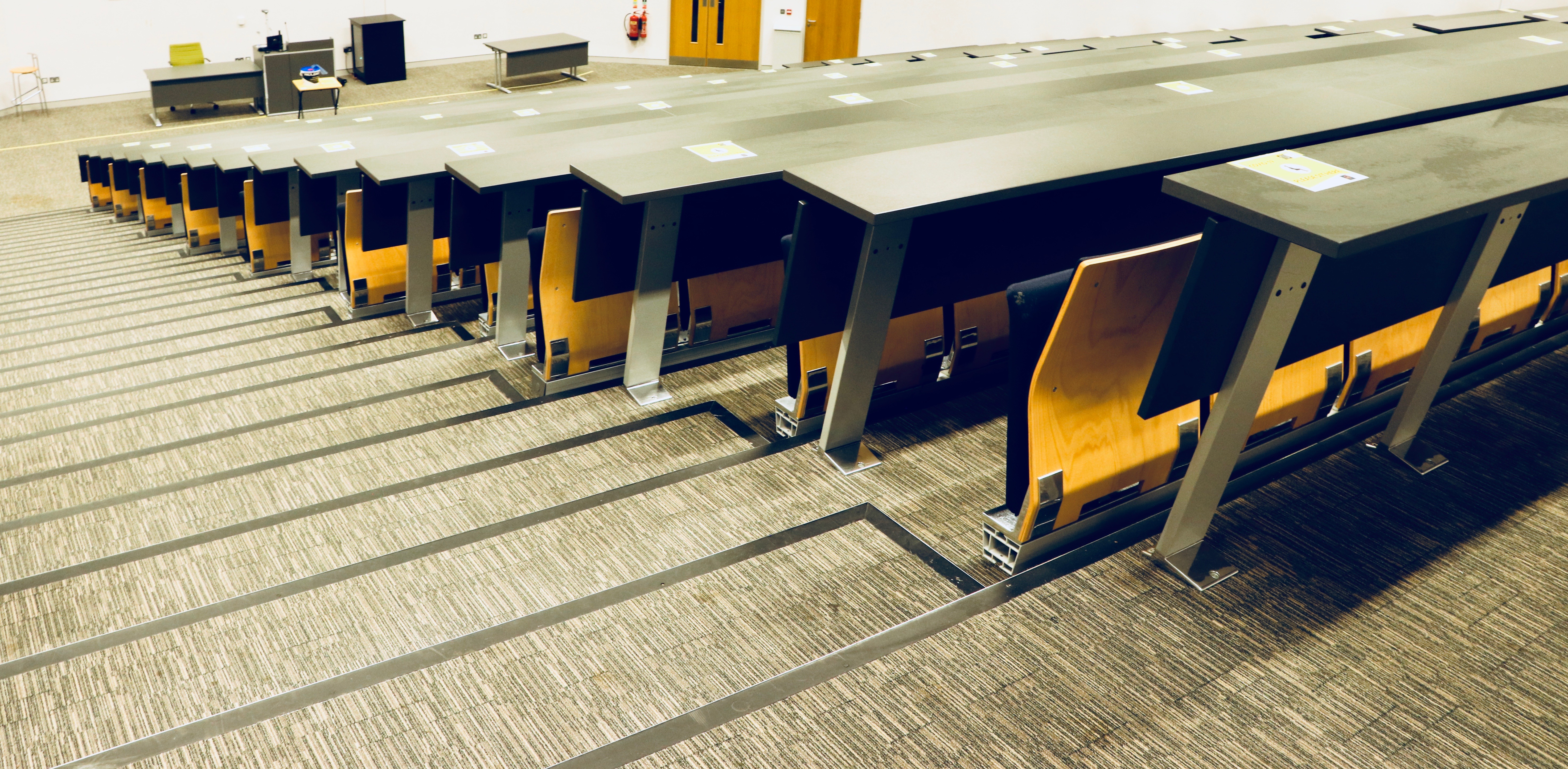
To shed light on the sudden transition of DCU’s large classes (100+ students) from the face-to-face teaching and learning setting to the online environment in March 2020 from the perspectives of staff and students;
To contextualise the findings arising from the examination of the transition referred to above by reviewing relevant literature; and
To inform the work (a) of academics in DCU teaching large-class cohorts and (b) of DCU’s academic developers and learning technologists, supporting them in this endeavour, as large programmes and modules move online in the forthcoming academic year.
This three-fold purpose guided our research design and data collection process with data collected from three sources: (1) a rapid, systematised review of relevant literature; 2) surveys of DCU students and staff who experienced the recent pivot of their large classes online; and (3) information relating to the TEU teaching supports provided to staff during the period March-June 2020. The support of the DCU Educational Trust allowed us to outsource the data analysis which would not have been tenable for the team to complete within our short project timeframe.
Just in Time Sharing
Our research team was committed to publishing guidelines for staff, as soon as possible, to support them in redesigning the large-class learning environment for the 2020/21 academic year. While the full report was not ready for publication, in early September 2020 a set of summary guidelines, drawing on the findings of the research, was collated and circulated to staff within DCU.
Moving Large Face-to-face Classes Online, provided timely guidance for staff across four key aspects of teaching online: curriculum design in the online space; teaching; learning and engagement; and assessment.
The guidance document was structured to offer both immediate and ongoing advice, thus supporting staff in the immediate context and also for online or hybrid contexts that are likely to increase in the future beyond COVID-19. In addition, the research team was committed to sharing the initial findings and guidance document with those teaching and learning in Higher Education beyond the DCU community. The findings were shared at several national and international events from June 2020, and we hope to continue this dissemination in the coming months.
From Challenge to Opportunity
While the study was borne of challenging times, we feel that the crisis placed a spotlight on teaching and learning and offered us as practitioners in Higher Education an invaluable opportunity to reflect on what constitutes good teaching and learning. While the focus was on the large cohort teaching context, we feel that the findings can inform practice in all teaching and learning contexts.
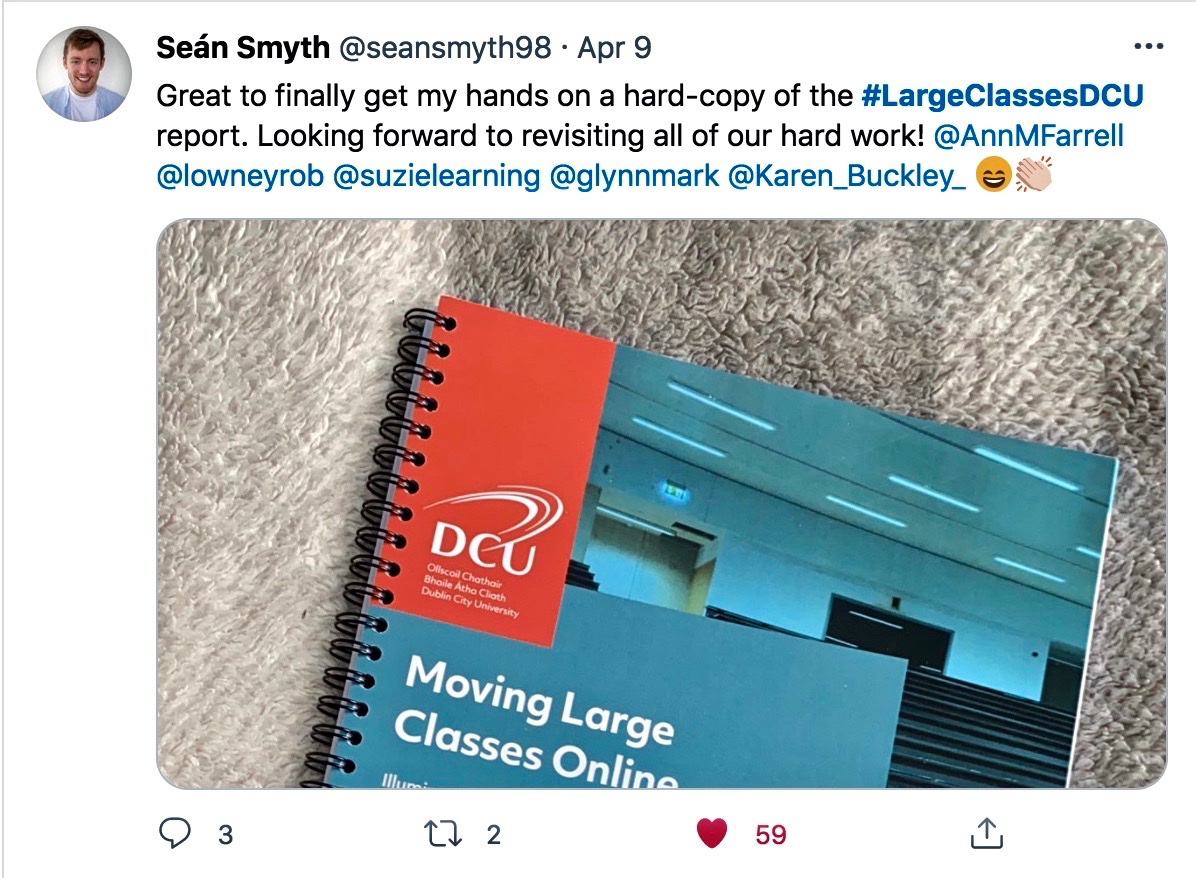
The final research report was published in February of this year and the warm response on social media and the engagement statistics have been most rewarding for the research team. Our hope is that this small research project offers some support for those teaching and learning in large cohort contexts, both in the current remote teaching context and into the future, which seems inevitably to include an increased level of remote and hybrid teaching and learning.
*Note: Karen Buckley has since taken up the role of Assistant Professor at the School of Special and Inclusive Education, Institute of Education.


 Digital Learning Dispatches