
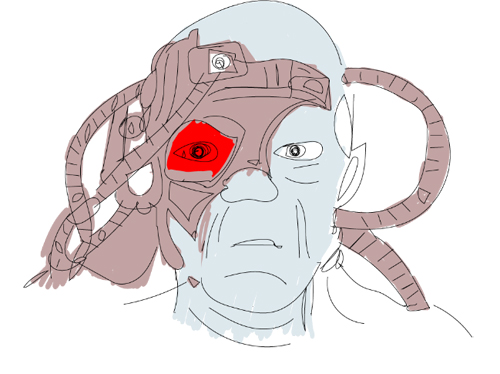
Lower the shields.
Adopt benign formation.
Send out a broadcast that the paywalls are down and that we come in peace.
Ready the torpedoes.
By Dr Eamon Costello, Dublin City University, & Dr Tom Farrelly Munster Technological University [Reposted with kind permission from the Ascilite blog ]
Shields play a big role in the fantasy sci-fi universe of Star Trek. One space-ship, when encountering another, can lower its shields as a sign of goodwill. It does this to put its hands up, to say that there is no need to worry and thus encourages the other ship to do the same. It may of course be trying to lull the other ship into a false sense of security – before blasting it into pieces that drift gently in the void.
This might be analogous to many educational technology vendors who made products free to access or use during the early phases of the pandemic. You can probably think of some. They offered access to services and products for free for a limited period. While some of these offers may have been well meaning, others could easily have been cynical ploys to hook new customers. Many of these initially free offerings quickly translate into paid subscription, acting like gateway drugs, slowly binding people to expensive products that will contribute ultimately to increased educational costs. These costs, somewhere along the line, will be borne by students. Big Tech companies have increased their power and reach greatly and we should not necessarily believe they will build back better, including in education.
The corresponding encroachment of digitalization in an intensifying platformization of education, denoting a process through which single enterprises and/or commercial networks engage in the ‘systematic collection, algorithmic processing, circulation and monetization of user data’
(Cone et al., 2021).
Academic journal publishers are one such type of vendor. Journal articles are a key component of higher education pedagogies, particularly at graduate level, where an entire course may be based around a list of journal article readings. During the early pandemic prominent journals made access to curated collections of relevant articles about online learning “freely” available, lowering the paywalls for educators to freely access. At the time of writing however these articles are no longer available to access except by subscription.
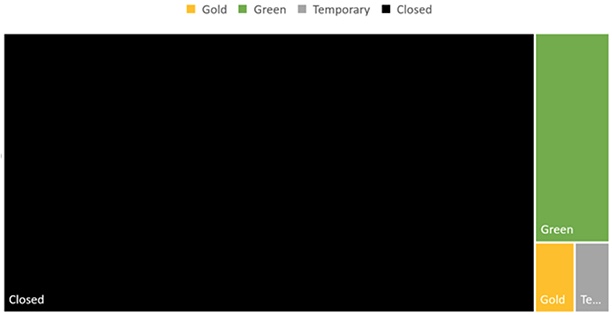
It is worth mentioning that almost all academic scholarship exists behind paywalls, including that of Educational Technology research. A bibliometric study (Costello et al 2020) that considered the status of 8,425 articles from 29 educational technology journals found that most published research in this area is not openly licensed and is hence the intellectual property of the publishers who charge (mostly universities) for access subscriptions. We found that 7,553 articles (89%) are locked up behind paywalls.
There are no easy solutions to the entangled relationships between scholars, journals, higher educational institutions and the publishing industry because there are structural and systemic issues to address. It is beyond the scope here to look into the heart of this issue which may be in part about the prestige upon which much of our ideas of education are built e.g. prestigious journals, prestigious institutions, prestigious modes of delivery (Javeri 2021) and ultimately prestigious or “better” people.
The sci-hub platform is considered illegal in most jurisdictions for breaking copyright and making scholarly and scientific publications freely available to the world – although some postulate its use as a valid form of civil disobedience. Sci-hub reportedly saw a huge surge in access to its papers during the pandemic, partly driven by those seeking access to research on the virus (Elbakyan & Bozkurt 2021).
Openness itself is not wholly good or uncomplicated. There are many opens (Costello et al 2019) and we always need to ask open to what exactly and what for (Bali et al 2020). Moreover we constantly need to renew its calls to action. As a recent ICDE open education project report puts it “the increasing cost of education, intensification of teacher’s workload, concerns about quality, and so on–and engender a stronger call to … go beyond the passionate community of advocates to achieve the goal of being embedded in mainstream practice.” (Farrell et al 2021)
However, to put it plainly here one simple thing we can try to do is reduce frictions for students and academics through access to research. There are many open access journals in the area of education technology. There are also ways authors can legally self-archive and share their work but these are not always apparent or straightforward as they are not the default option. Journals such as AJET, supported by the ASCILITE community, is a key bastion of the open education ecosystem and all of its members and supporters should be justly proud.
There is a colourful history of the metaphors of learning technology (Farrelly et al 2020) and it may be worth invoking one more. Defensive shields are not the only Star Trek military technology that big entities use. Another are cloaking devices:
Cloaks can hide as well as they can protect. The question is: whose interests are they protecting and whose are they hiding?
References:
Bali, M., Cronin C., Czerniewicz L., DeRose R., k, & Jhangiani R., (2020) Open at the margins: Clinical perspectives on open education. Rebus Community. ISBN: 978-1-989014-22-6
Cone, L., Brøgger, K., Berghmans, M., Decuypere, M., Förschler, A., Grimaldi, E., Hartong, S., Hillman, T., Ideland, M., Landri, P. & van de Oudeweetering, K. (2021). Pandemic Acceleration: Covid-19 and the emergency digitalization of European education. European Educational Research Journal, 14749041211041793
Costello, E., Farrelly, T. & Murphy, T. (2020). Open and shut: Open access in hybrid educational technology journals 2010 – 2017. International Review of Research in Open and Distributed Learning, 21 (1), 113-134.
Costello, E., Huijser, H., & Marshall, S. (2019). Education’s many “opens”. Australasian Journal of Educational Technology, 35(3).
Elbakyan, A., & Bozkurt, A. (2021). A Critical Conversation with Alexandra Elbakyan: Is she the Pirate Queen, Robin Hood, a Scholarly Activist, or a Butterfly Flapping its Wings? Asian Journal of Distance Education, 111-118.
Farrell, O., Aceto, S., Baldiris, S., Brown, M., Brunton, J., (2021). The Current State of OER in Europe: Going Beyond Altruism. ENCORE+ OER Policy and Strategy Position Paper No. 1. Retrieved 09/09/2021 from https://encoreproject.eu/wp-content/uploads/2021/09/ENCORE-OER-Policy-Circle-Position-paper-n.1.pdf
Farrelly, T., Costello, E., & Donlon, E. (2020). VLEs: A metaphorical history from sharks to limpets. Journal of Interactive Media in Education, 2020(2), 1-10.
Javeri S. (2021) How Remote Learning Subverts Power and Privilege in Higher Education. EdSurge. Retrieved 09/09/2021 from https://www.edsurge.com/news/2021-09-06-how-remote-learning-subverts-power-and-privilege-in-higher-education


 Digital Learning Dispatches