
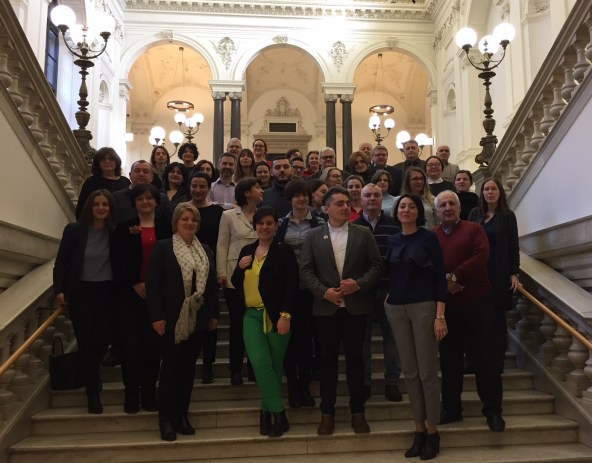
Dr Mark Glynn and Dr Laura Costelloe from the Teaching Enhancement Unit (TEU) were in Vienna last week to lead and contribute to a series of productive meetings and development workshops with project partners for the Erasmus+ funded INTEGRITY project.

INTEGRITY (Academic Integrity for Quality Teaching and Learning in Higher Education Institutions in Georgia) is a two-year collaboration project with colleagues in partner institutions in Ilia State University (Georgia), University of Roehampton (UK), Uppsala Universitet (Sweden) and Universität Wien (Austria) as well as a range of associated HEIs in Georgia. This Erasmus+ project, funded under the KA2 strand, is aimed at enhancing the quality of teaching and learning processes that are based on the principles of academic integrity, supported by policies, mechanisms and tools that help prevent and detect cases of plagiarism in higher education institutions in Georgia. More specifically the project aims to support:
• the successful introduction of plagiarism prevention and detection electronic tools in Georgian HEIs;
• the design and launch of an information campaign in Georgian HEIs defining academic integrity and promoting best practice principles of academic integrity;
• the development of faculty in the area of effective assessment, teaching and learning to promote academic integrity.
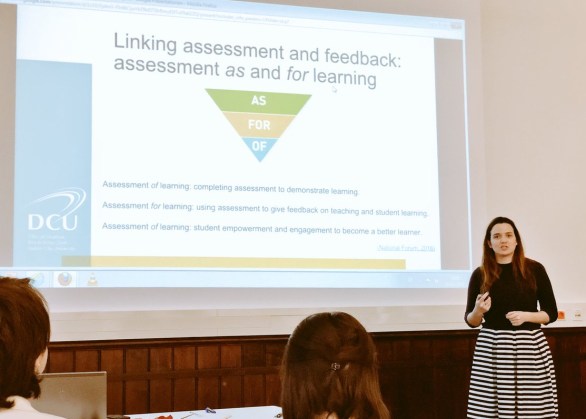
The main inputs from the TEU were centred around the provision of professional development for academic staff in Georgian partner institutions, with a particular focus on how various approaches to assessment and feedback can promote academic integrity, as well as examining how technology – including text-matching software – can play an important role in promoting academic integrity and detecting incidents of plagiarism. The TEU team led an interactive faculty development workshop on assessment design for academic integrity, complemented by a presentation on giving feedback to students on academic writing. Dr Mark Glynn also delivered a series of demonstrations highlighting the benefits of technology and text-matching tools such as as Urkund and Turnitin for both academic staff and students to promote academic integrity.
The next steps for the TEU in this project involve the development of a suite of resources for academic faculty and students, designed to promote academic integrity and reduce plagiarism. The TEU is currently building an assessment design ‘toolkit’ for higher education teachers; this will include resources (e.g. videos, guides, self-assessment activities and case studies) which can be used by individual academics when approaching the design of assessments; alternatively the toolkit might be used by programme leaders or academic developers to deliver a workshop on assessment design for academic integrity.
 Contemporary literature suggests that effective assessment design can ensure more authentic assessments which reduce the opportunities for students to breach academic integrity standards and ‘outsource’ assignments to third parties or essay mills (see for example, Newton & Lang, 2016; Carroll & Appleton, 2001). It is expected that this toolkit will be launched in Autumn 2018 in time for the new academic year. The TEU team is also working with partners in the University of Roehampton to build on existing resources in the areas of academic writing, citation and referencing for students and this material will be freely shared with INTEGRITY project partners and other interested parties.
For more information on the INTEGRITY project please contact Dr Laura Costelloe (Laura.Costelloe@dcu.ie; @Lostelloe) or Dr Mark Glynn (Mark.Glynn@dcu.ie; @glynnmark).
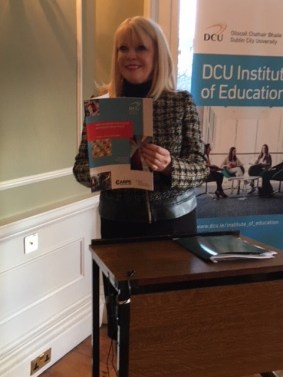
 The launch took place in the historic Belvedere House on Dublin City University’s (DCU) St Patrick’s campus, which is the main location of the
 Professor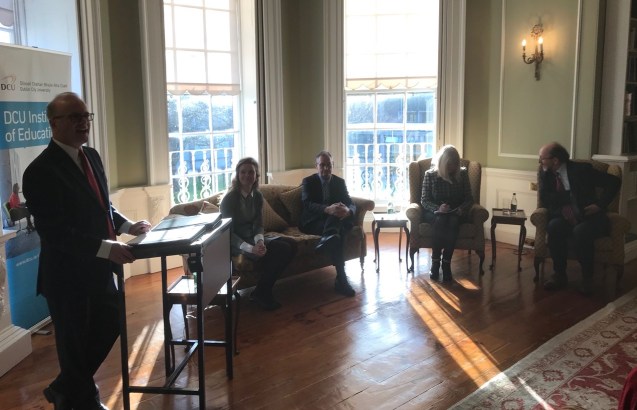



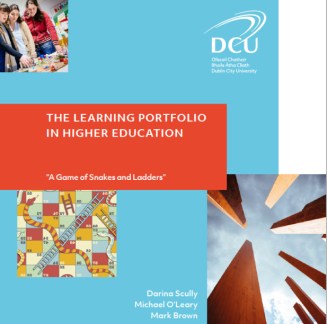
 Although the theory underlying the use of learning portfolios is promising, robust empirical evidence supporting their effectiveness remains sparse. A large proportion of the literature published on the topic has either been purely theoretical in nature, or has focused on the technological platforms used to support learning portfolio construction. Of the few studies reporting outcomes of learning portfolio use, the vast majority have done so solely in terms of self- reported attitudes and perceptions of stakeholders, as opposed to achievement data or demonstrable competencies. Moreover, almost all of these studies have been conducted over relatively short periods of time.
 One clear message emerging from the extant literature is that simply requiring students to use learning portfolios will not necessarily foster the desired outcomes. The tool is rooted in a complex pedagogy, and its potential can only be realised if the processes underlying this pedagogy (e.g. re ection) are properly understood by advocates and executed by users. In addition, there is recurring tension between the developmental (process) and evaluative (product) conceptualizations of the learning portfolio, and this may be further aggravated by recent attempts to integrate digital badging within the tool.
 Digital Learning Dispatches