Yes! Digital Learners are Emotional – Insights from the Irish 101 MOOC

Many people believe that online learning can be a lonely journey for a learner and the experience of learning online is often described in disconnected terms. However, many credible studies into learning online demonstrate that learners experience a wide range of emotions as they engage in the online environment. Elaine Beirne, a researcher in The Ideas Lab at the National Institute of Digital Learning in DCU, and inaugural OLC Emerging Scholar, is researching the emotions of beginner language learners in Irish language MOOCs.

N18019

Irish 101Her findings to date have been quite revealing. Research into traditional language learning settings has identified anxiety or foreign language anxiety as one of the main emotions experienced by learners.

Elaine’s research in the Irish 101: Introduction to Irish Language and Culture course hosted on the FutureLearn platform, however, identifies curiosity, excitement and pride as the top three emotions reported by learners. Learners completed a number of short surveys following some of the course’s learning activities.  This baseline study is now being extended to a further iteration of the Irish 101 course, due to commence in May of this year.

Elaine is currently recruiting participants who would be interested in undertaking the MOOC and reporting their emotions in the short surveys as they progress through the course. Elaine explains more about the study* in the short video above and if you are interested in participating and helping the Fáilte ar Líne project to improve course design for language learners register here. The Fáilte ar Líne project is co-funded by the Department of Culture, Heritage and the Gaeltacht under the Twenty Year Strategy for the Irish Language with support from the National Lottery and it is is a joint project of the NIDL and Fiontar & Scoil na Gaeilge.

A world without emotions would be cold and colourless.

(Williams, Mercer, Ryan, 2015: 81)

maoinitheoirí_2018.JPG

References

Williams, M., Mercer, S. & Ryan, S., 2015. Exploring Psychology in Language Learning and Teaching, Oxford University Press, Oxford, pp.170

*Ethical approval received from DCU’s Research Ethics Committee. Reference number: recdcu/2018/044

Excellent Start to INTEGRITY Project at the University of Vienna

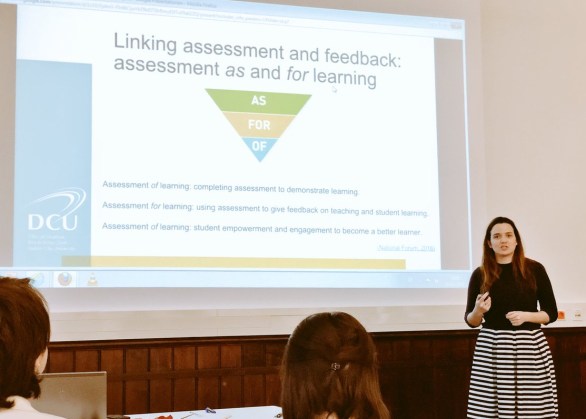
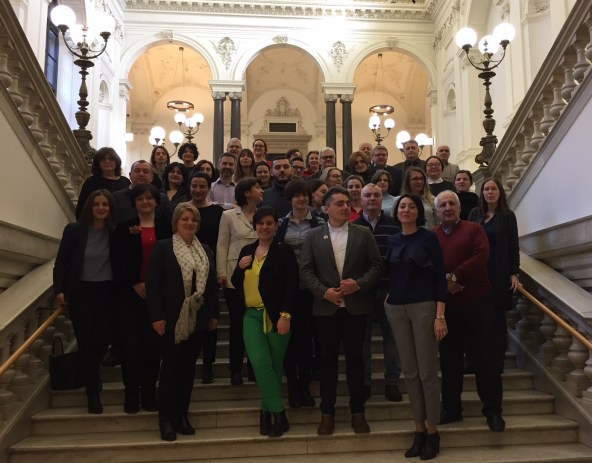
Dr Mark Glynn and Dr Laura Costelloe from the Teaching Enhancement Unit (TEU) were in Vienna last week to lead and contribute to a series of productive meetings and development workshops with project partners for the Erasmus+ funded INTEGRITY project.  

Vienna Academic Integrity 1.jpg

INTEGRITY (Academic Integrity for Quality Teaching and Learning in Higher Education Institutions in Georgia) is a two-year collaboration project with colleagues in partner institutions in Ilia State University (Georgia), University of Roehampton (UK), Uppsala Universitet (Sweden) and Universität Wien (Austria) as well as a range of associated HEIs in Georgia. This Erasmus+ project, funded under the KA2 strand, is aimed at enhancing the quality of teaching and learning processes that are based on the principles of academic integrity, supported by policies, mechanisms and tools that help prevent and detect cases of plagiarism in higher education institutions in Georgia. More specifically the project aims to support:

• the successful introduction of plagiarism prevention and detection electronic tools in Georgian HEIs;

• the design and launch of an information campaign in Georgian HEIs defining academic integrity and promoting best practice principles of academic integrity;

• the development of faculty in the area of effective assessment, teaching and learning to promote academic integrity.

IMG_1546.JPG

The main inputs from the TEU were centred around the provision of professional development for academic staff in Georgian partner institutions, with a particular focus on how various approaches to assessment and feedback can promote academic integrity, as well as examining how technology – including text-matching software – can play an important role in promoting academic integrity and detecting incidents of plagiarism. The TEU team led an interactive faculty development workshop on assessment design for academic integrity, complemented by a presentation on giving feedback to students on academic writing. Dr Mark Glynn also delivered a series of demonstrations highlighting the benefits of technology and text-matching tools such as as Urkund and Turnitin for both academic staff and students to promote academic integrity. 

DWAURX9W4AYPKdG.jpg

The next steps for the TEU in this project involve the development of a suite of resources for academic faculty and students, designed to promote academic integrity and reduce plagiarism. The TEU is currently building an assessment design ‘toolkit’ for higher education teachers; this will include resources (e.g. videos, guides, self-assessment activities and case studies) which can be used by individual academics when approaching the design of assessments; alternatively the toolkit might be used by programme leaders or academic developers to deliver a workshop on assessment design for academic integrity.

Vienna Academic Integrity 2.jpegContemporary literature suggests that effective assessment design can ensure more authentic assessments which reduce the opportunities for students to breach academic integrity standards and ‘outsource’ assignments to third parties or essay mills (see for example, Newton & Lang, 2016; Carroll & Appleton, 2001). It is expected that this toolkit will be launched in Autumn 2018 in time for the new academic year. The TEU team is also working with partners in the University of Roehampton to build on existing resources in the areas of academic writing, citation and referencing for students and this material will be freely shared with INTEGRITY project partners and other interested parties.

For more information on the INTEGRITY project please contact Dr Laura Costelloe (Laura.Costelloe@dcu.ie; @Lostelloe) or Dr Mark Glynn (Mark.Glynn@dcu.ie; @glynnmark).