Go Open: A Beginner’s Guide to Open Education

The Go Open project is a collaborative initiative based in Dublin City University (DCU) comprising a team from the DCU Library, Open Education Unit and the Digital Learning Design Unit.

Led by Dr Orna Farrell, the project aims to support the DCU Community to engage with Open Educational Practices (OEPs) in their teaching, research and support activities. The Go Open Project is funded by the National Forum for the Enhancement of Teaching and Learning in Higher Education and DCU’s Teaching Enhancement Unit (TEU) through the SATLE 19 fund.

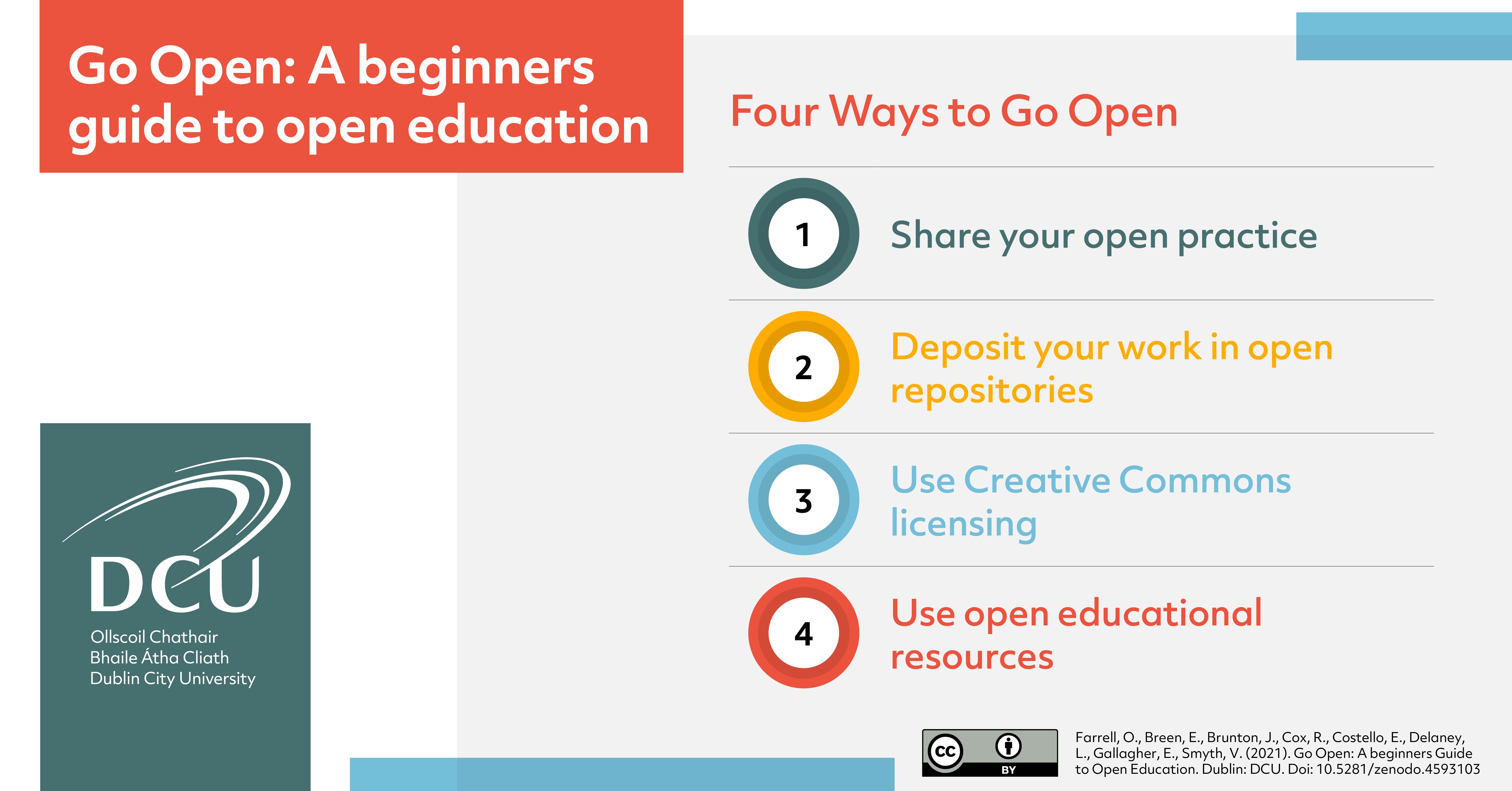
The project team has produced a number of open access resources published under creative commons licenses (CCL) designed for academics and professional support staff to begin engaging with OEPs and to take small steps towards going open!

Go Open Resources

You can already access the following two resources…

Go Open Launch Webinar

We invite you to join us at the Go Open launch event at 10:00am (IST) on Thursday the 29th of April. 

  • The webinar will feature a keynote talk by Dr Catherine Cronin from the National Forum about the three pillars of Open Education.
  • A panel discussion about getting started with Open Educational Practices
  • The Launch of the Go Open digital resources 

Register via eventbrite here.

Other OER/OEP initiatives

The NIDL is currently involved in two other major European-funded OER/OEP projects, including ENCORE and OpenGame. As part of the latter initiative, in 2020 the project team published this Handbook of Successful Open Teaching Practices which places an emphasis on how OER/OEP can be used to address some of the current challenges facing educators and students.

Call for Papers on Micro-credentials and the Next New Normal

Is the micro-credential the next big thing? The micro-credentialing movement is gaining momentum around the world as more governments, universities and professional organisations respond to powerful change forces of Industry 4.0 along with the impact of the COVID-19 pandemic.

But is the magic of the micro-credential fairy dust or star dust? Is the micro-credential just the latest educational fad in a long list of failed learning innovations over many years?

These are some of the provocative questions that we will be exploring in Higher Education 4.0: Certifying Your Future, our forthcoming online masterclass available through the FutureLearning platform. We are looking forward to some lively online debates over the next few weeks. Make sure you register for this course.

Google Trend data for the microcredential

We are also pleased to announce a special issue of the International Journal of Educational Technology in Higher Education will publish a collection of papers which critically and analytically focus on micro-credentials as the “next new normal” for digitally-enhanced learning in higher education ecosystems.  Micro-credentials are purported to offer more flexible, digitally-enabled, learner-focused, and wide-reaching education and training opportunities for learners. Whilst the emergence, adoption, regulation, and impact of micro-credentials and other forms of digital credentials present a number of opportunities, they also raise important questions and challenges for all stakeholders (i.e. learners, employers, educational institutions, and government and professional bodies).

Topics in this special issue include, but are not limited to: 

  • Institutional and national credentialing processes
  • Strategies, governance and policies
  • Credential ecology, quality assurance and recognition frameworks
  • Co-construction of micro-credentials, employability, lifelong and lifewide learning
  • Transversal skill
  • Neoliberal ideologies
  • Academic trajectories
  • Value propositions of micro-credentials

As part of the NIDL’s commitment to open science, open scholarship and open education we greatly value our role as a formal editorial partner in this Springer published journal, which has developed a strong following and reputation for quality in recent years. Indeed, the International Journal of Educational Technology in Higher Education is now officially the No 1 Scopus ranked open access publication in the field.

You can read more about this special issue and how to submit a manuscript on the journal website.

Submission deadline: 31 July 2021

Guest Editors: Beverley Oliver, Mark Brown, Mairéad Nic Giolla Mhichíl

Masterclass starts March 8th 2021

`