The 28th ICDEWorld Conference on Online Learning in Dublin, Ireland is now less than a year away and the team in National Institute for Digital Learning (NIDL) at Dublin City University (DCU) has been busy over recent weeks preparing for the conference. The last conference in 2017 in Toronto attracted around 1,400 delegates and this year’s Organising Committee promise a truly unique Irish experience along with an exciting and engaging conference programme.
The call for papers went out on Monday 19th November and in the context of the conference theme of “Transforming Lives and Societies” a range of opportunities will be available for participants to discuss many of the contemporary issues facing today’s educators. There will be a variety of invited symposia and pre-conference workshops along with a special event for doctoral students but also plenty of time for delegates to mix socially and enjoy the sights and delights of Dublin. Note the conference key dates and watch out over the next few months for further news and updates, including how to enter our special monthly draw to win tickets to visit the iconic Guinness Storehouse during your stay in Dublin. You may also wish to follow the World Conference twitter handle:
@WCOL2019
In the meantime you view a brief video below where members of the local organising team from DCU mark the one-year milestone before researchers, policy-makers institutional leaders and educational professionals from around the world gather in Dublin in November 2019.
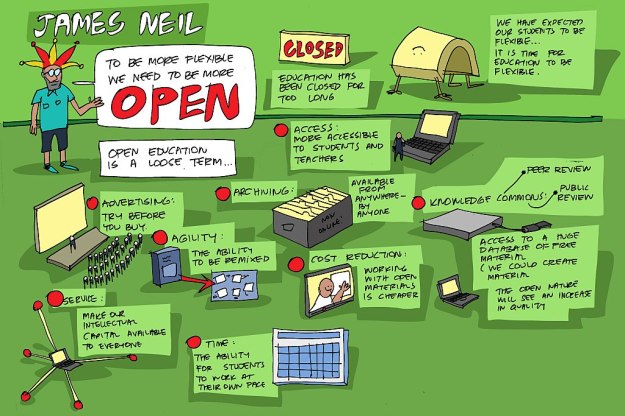
Gráinne Conole and Mark Brown recently published an invited article and critically reflective think-piece in the Journal of Learning for Developmentproduced by the Commonwealth of Learning. The focus of the paper was a critique of the impact of the Open Education movement on higher education. It considered the impact of adopting more open practices on: learning, teaching and research. In terms of the impact on learning it described three aspects: Open Educational Resources, Open Textbooks and Massive Open Online Courses. In terms of the impact on teaching it describes three frameworks which can guide the design process: the 7Cs of Learning Design framework (Conole, 2016), the SAMR model (Puentedura, 2013) and the ICAP framework (Chi & Wylie, 2014). Finally, it considered the impact on research and touches on the growing Open Science movement. The article concludes by considering the barriers and enablers associated with adopting more open practices.
The paper argued that open practices have many facets and are complex, they are not new but are having an increasingly impact in education as a result of new digital technologies and in particular how people are deploying social media. There is a lot of rhetoric around the potential of open practices and naïve assumptions about their impact, but it is important to caution against this; they are not inherently good in themselves, but it is more to do with how they are appropriated. In other words, the nature of and benefits of open practices depends on the context, i.e. how they are applied and implemented. Cronin (2017) argues that the use of open practices by learners and educators is complex, personal, and contextual; it is also continually negotiated. Higher Education institutions require collaborative and critical approaches to openness in order to support academics, students, and learning in an increasingly complex Higher Education environment. Olcott (2013) argues that openness and open education needs to be viewed along a continuum with varying degrees of openness and access to knowledge as the guiding core principle.
Building on these perspectives we argue that openness is fluid, constantly evolving and can be understood using the metaphor of a kaleidoscope where different shapes, colours and patterns come together as visually attractive images, but they can change before your eyes and often in unpredictable ways. In order to critically read the different change forces and competing and co-existing perspectives influencing the Open Education movement, and the images they produce when mixed together, a type of double vision is required, which combines both a political and pedagogical lens. This bifocal view endeavours to strike a balance between the language of opportunity, firmly anchored in the mission of equity and opening access, set against a deeper level of critique.
The paper concludes by arguing that OER and MOOCs are important as they get us to think more about the learner experience and they challenge traditional educational offerings. However, more needs to be done to increase the uptake and use of OER and MOOCs anchored within sound pedagogical models. We need to more deeply understand what new digital literacies are needed to harness the open practice affordances of new digital technologies, particularly in terms of achieving the goal of education for all. There remains a distinct lack of discourse on OER and MOOCs at policy and strategy level and this urgently needs to be addressed if we are to truly promote the openness agenda. We also need to focus more on the development of senior educational leaders with an understanding of digital technologies and a vision for OEPs. There are also financial implications; institutions need to understand why they are investing in OER and MOOCs and how to evaluate their efforts. Importantly, we are teaching students for an uncertain future, to do jobs that we are being told may not even exist in the future. Therefore, we need to go beyond knowledge recall to develop the skills and competencies they need for life-long learning in the 21stCentury to be critical thinkers, critical consumers and critical citizens.
References
Chi, M.T.H., & Wylie, R. (2014), The ICAP Framework: Linking Cognitive Engagement to Active Learning Outcomes, Educational Psychologist, 49:4, 219-243.
Conole, G. (2016), The 7Cs of Learning Design, in J. Dalziel (Ed.), Learning Design – state of the art of the field, London: Routledge.
Olcott, D. (2013), Access under siege: Are the gains of open education keeping pace with the growing barriers to university access?, Open Praxis, Vol. 5, Issue 1, 15-20, available online at https://openpraxis.org/index.php/OpenPraxis/article/view/14/3, last accessed 28thJune 2018.



 Digital Learning Dispatches
