Call for Papers on Micro-credentials and the Next New Normal

Is the micro-credential the next big thing? The micro-credentialing movement is gaining momentum around the world as more governments, universities and professional organisations respond to powerful change forces of Industry 4.0 along with the impact of the COVID-19 pandemic.

But is the magic of the micro-credential fairy dust or star dust? Is the micro-credential just the latest educational fad in a long list of failed learning innovations over many years?

These are some of the provocative questions that we will be exploring in Higher Education 4.0: Certifying Your Future, our forthcoming online masterclass available through the FutureLearning platform. We are looking forward to some lively online debates over the next few weeks. Make sure you register for this course.

Google Trend data for the microcredential

We are also pleased to announce a special issue of the International Journal of Educational Technology in Higher Education will publish a collection of papers which critically and analytically focus on micro-credentials as the “next new normal” for digitally-enhanced learning in higher education ecosystems.  Micro-credentials are purported to offer more flexible, digitally-enabled, learner-focused, and wide-reaching education and training opportunities for learners. Whilst the emergence, adoption, regulation, and impact of micro-credentials and other forms of digital credentials present a number of opportunities, they also raise important questions and challenges for all stakeholders (i.e. learners, employers, educational institutions, and government and professional bodies).

Topics in this special issue include, but are not limited to: 

  • Institutional and national credentialing processes
  • Strategies, governance and policies
  • Credential ecology, quality assurance and recognition frameworks
  • Co-construction of micro-credentials, employability, lifelong and lifewide learning
  • Transversal skill
  • Neoliberal ideologies
  • Academic trajectories
  • Value propositions of micro-credentials

As part of the NIDL’s commitment to open science, open scholarship and open education we greatly value our role as a formal editorial partner in this Springer published journal, which has developed a strong following and reputation for quality in recent years. Indeed, the International Journal of Educational Technology in Higher Education is now officially the No 1 Scopus ranked open access publication in the field.

You can read more about this special issue and how to submit a manuscript on the journal website.

Submission deadline: 31 July 2021

Guest Editors: Beverley Oliver, Mark Brown, Mairéad Nic Giolla Mhichíl

Masterclass starts March 8th 2021

`

Successful Launch of ENCORE+ Project to Create a European Network for Catalysing OERs in Education

A team from the NIDL comprising of Dr. Orna Farrell, Dr. James Brunton and Prof. Mark Brown is pleased to be representing DCU as an active partner in a new EU Erasmus+ funded project called ENCORE+: The European Network for Catalysing Open Resources in Education. 

The project aims to create a European network that supports innovation and entrepreneurship with Open Educational Resources (OERs). While current evidence suggests there are pockets of engagement with OER in European academic and business contexts, there is no fully integrated European OER university-business ecosystem able to identify, catalyse and share best practices. 

Photo by Artem Beliaikin on Unsplash

The ENCORE+ project seeks to address this gap. The scope of the initiative also includes promoting Open Educational Policies (OEPs1) and Open Educational Practices (OEPs2) through business and academia by sharpening value propositions and implementation strategies for OER use in higher education and the world of work. 

During the next 3-years, the initiative aims to use its funding (€993K) to create four strong European networks which will consolidate a new vision and understanding of how OER and OEPs can foster innovation in higher education and business.

ENCORE+ aims to bring about an overarching consensus through sharing expertise across business and higher education; and will sustain community ‘Circles’ that will apply, validate and disseminate outcomes. The goal is to build a stronger foundation for a European OER Ecosystem which can best support:

  • Innovation and inclusion in education and training;
  • Improve digital skills; 
  • Improve employability; and 
  • Share the benefits of open online learning with as many Europeans as possible.

Some of the project outputs and deliverables include:

  • Developing a validated, shared vision and roadmap for OER in Europe;
  • Providing a sustainable European collaboration model which responds to authentic needs;
  • Working with diverse stakeholders to create and pilot the ENCORE+ OER Quality Framework;
  • Establishing European OER Strategy Guidelines for higher education and businesses,
  • Establishing a well-connected European OER Ecosystem of technologies and communities.

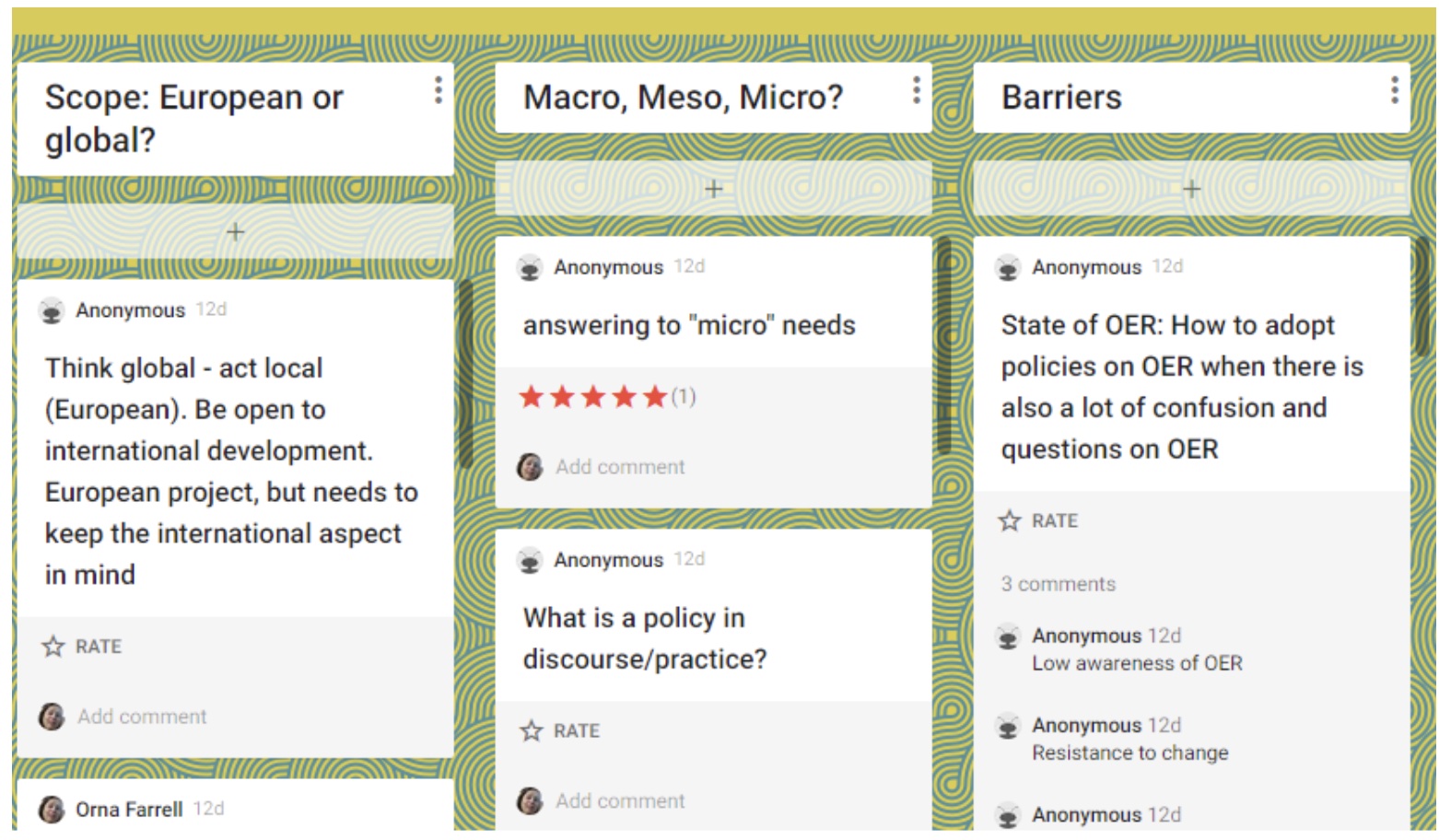
The project team has committed itself to a really innovative and collaborative approach to sharing knowledge and practice about open education, which was evident in our recent series of kick off meetings. DCU is leading a work package related policy and strategy and the Padlet image above from our recent envisioning and information sharing workshop offers some initial thoughts. 

Project Partners:

  • International Council for Open and Distance Education (ICDE), Norway (Project Coordinator)
  • Baden-Wuerttemberg Cooperative State University (DHWB), Germany
  • Dublin City University (DCU), Ireland
  • International University of La Rioja (UNIR), Spain
  • Joubel AS (JOUBEL), Norway
  • Knowledge 4 All Foundation Ltd (K4A), United Kingdom
  • Instructure Global Ltd. (CANVAS), United Kingdom
  • The Open University (OUUK), United Kingdom

If you would like to hear more about this exciting and ambitious project, then members of the ENCORE+ project team will be contributing to a panel discussion as part of EDEN’s Webinar Series during Open Education Week. You can register for this webinar scheduled for Tuesday, 2nd March 2021, 16:30 (CET) through the EDEN website.