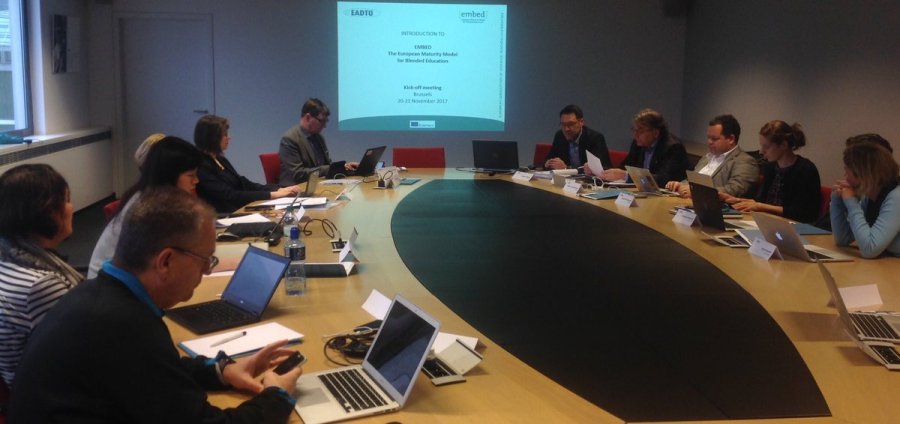
Earlier this week the first face-to–face meeting of the new European funded EMBED Project took place in Brussels. This project aims at offering higher education institutions expertise and guidance by developing a conceptual framework and a European maturity model on blended education. The EMDED Project involves a strategic partnership between the European Association of Distance Teaching Universities (EADTU), Delft University, University of Edinburgh, KU-Leuven, Aarhus University, Tampere University of Applied Sciences, and the NIDL at Dublin City University. It brings together recognised specialists in blended education to build a multi-level maturity model and framework for pedagogical and institutional change based on progress markers related to stakeholder-focused outcomes. Importantly, the project adopts a multi-level conception of blended education, including micro-level teaching and learning processes, meso-level institutional innovation and enabling strategies, and macro-level governmental policy and support structures.
One of the challenges for the project team, particularly during the establishment phase, is to develop a shared conception of blended education, which goes beyond many of the narrow and instrumentalist definitions in the literature. In this regard, the adoption of the term “blended education”, as distinct from “blended learning”, is not insignificant, especially if the project aims to encapsulate a more dynamic, transformative and future-focused understanding of the concept.
The current reality is that there are many definitions of blended learning in the literature and even leading proponents of the concept do not always agree on what they mean by the term. While Garrison and Kanuka’s (2004) definition that ‘At its simplest, blended learning is the integration of classroom face-to-face learning experiences with online learning experiences’ (p.96) is frequently cited, and this conception is reiterated in the original Handbook of Blended Learning (Graham, 2006), there is still no singularly accepted definition in the literature.
This point begs the question, what is unique about the EMBED Project and the focus on blended education?
After all, the idea of blending is not new and there have been many efforts over the past decade to describe the different affordances of pedagogically rich blended learning experiences. For example, the “COFA videos” produced by Simon McIntyre and colleagues at the University of New South Wales in Australia as part of the multi-award winning “Learning to Teach Online” project, which first began in 2009, and later evolved into a high profile MOOC offered on the Coursera platform, continue to be used for professional learning purposes.

One of the important lessons from this innovative project, and the literature more generally over the past decade (see for example, Daniel, 2016; Oliver & Trigwell, 2005; Siemens, Gasevuc & Dawson, 2015), is that popular conceptions of blended learning often fail to encapsulate a sense of pedagogical disruption. According to Norm Vaughan (2007), a valued member of the NIDL’s International Advisory Board, blended learning should be seen as an opportunity to fundamentally redesign or transform how we approach teaching and learning so that higher education institutions may benefit from increased effectiveness, convenience and efficiency.
In this sense, the concept of blended learning (or education) goes beyond the mere integration of face-to-face learning with online activities at the micro-level. As Garrison and Vaughan (2008) argue in their seminal book on the topic, ‘Blended learning is not an addition that simply builds another expensive educational layer’ (p.5). On the contrary, it should challenge us to do things differently and serve as a catalyst for helping educators to reimagine the nature of teaching and learning in the digital-era.
Put another way, blended education should be seen as an opportunity to rethink, redesign and where appropriate fundamentally transform the traditional model, structure and delivery methods of higher education. Borrowing the words of Moskal, Dziuban and Hartman (2013), blended learning [education] is a dangerous idea as it questions the status quo and has the potential to seriously challenge many traditional sacred cows of what constitutes good pedagogy.
What does this line of thinking mean for the EMBED project?
In simple terms the concept of blended learning means different things to different people. The key point is that there is an inherent tension between traditional conceptions of blended learning, which attempt to merely “tame” the potential of digital technology based on relatively conventional pedagogies, as opposed to more transformative efforts to fully “exploit” the affordances of new digital technologies as part of a wider strategy to modernise the higher education system.
 The challenge for the project team is to recognise, carefully navigate and strike a balance between these competing and co-existing perspectives. A related challenge is that the concept of a maturity model is potentially an oxymoron in an era of such rapid and dynamic change. As the project evolves, therefore, we will need to grapple with and develop creative solutions to how we frame the idea of maturity at the different levels (micro, meso and macro) in ways that recognise the fluid and rapidly evolving nature of the field. In other words, we have set ourselves a challenge of focusing greater attention, rather than narrowly the focus, on blended education in the context of the wider changing higher education landscape.
Footnote: We hope to launch the EMBED Project website in the next few weeks.
References
Daniel, J. (2016). Making sense of blended learning: Treasuring an older tradition or finding a better future? Contact North, Canada.
Garrison, D. R., & Kanuka, H. (2004). Blended learning: Uncovering its transformative potential in higher education. The Internet and Higher Education, 7(2), pp. 95–105.
Garrison, R., & Vaughan, N. (2008) Blended learning in higher education: Framework, principles, and guidelines. San Francisco: Jossey-Bass.
Graham, C. (2006). Blended learning systems: Definition, current trends, and future directions (pp. 3–21). In C. Bonk & C. Graham (eds.) The handbook of blended learning: Global perspectives, local designs. San Francisco: John Wiley & Sons, Inc.
Moskal, P., Dziuban, C., & Hartman, J. (2013). Blended learning: A dangerous idea? Internet and Higher Education 18: pp. 15–23.
Oliver, M., & Trigwell, K. (2005). Can blended learning be redeemed? E-learning 2(1). pp. 17–26.
Siemens, G., Gasevuc, D., & Dawson, S. (2015). Preparing for the digital university: A review of the history and current state of distance, blended, and online learning. Athabasca University.
Vaughan, N. (2007). Perspectives on blended learning in higher education. International Journal on E-Learning, 6(1), pp. 81-94.



 As hopefully you can tell from the selected images the two themes were Pirates and Western. At first this was a rather daunting task for people in the face of two large blank canvasses (walls). However, after a brief 101 tutorial on the basics of drawing and painting graffiti from our two expert mentors, each team set about their task by brainstorming possible concepts, sketching out initial designs and learning how to hold and spray a paint can.


 Digital Learning Dispatches