Top 10 Open Access Journal Articles for 2018: Our Final Selection

Over the past week we have been sharing via Twitter our selection of the top 10 open access journal articles for 2018. This is the third year that the NIDL team has undertaken this exercise. You can read more about our selection criteria and previous top 10 selections for 2017 and 2016 in earlier blog posts. We will also be posting a more detailed blog explaining each of our selections for 2018 along with general comments and observations arising from the experience. In the meantime here is the final list of our top 10 articles for the year:
Top 10.jpg

The Top 10

No. 1

An Analysis of Peer Reviewed Publications on Openness in Education in Half a Century: Trends and Patterns in the Open Hemisphere, in Australasian Journal of Educational Technology by Aras Bozkurt, Suzan Koseoglu and Lenandlar Singh

No. 2

Helping Doctoral Students Crack the Publication Code: An Evaluation and Content Analysis of the Australasian Journal of Educational Technologyin Australasian Journal of Educational Technology by Melissa Bond

No. 3

Dawn or Dusk of the 5th Age of Research in Educational Technology? A Literature Review on (e-)Leadership for Technology-enhanced Learning in Higher Education (2013-2017), in International Journal of Educational Technology in Higher Education by Deborah Arnold and Albert Sangrà

 No. 4

UK Higher Education Institutions’ Technology-enhanced Learning Strategies from the Perspective of Disruptive Innovation, in Research in Learning Technology by Michael Flavin and Valentina Quintero

No. 5

Twenty-years of EDECH, in EDUCAUSE Review by Martin Weller

No. 6

Digital Competence and Digital Literacy in Higher Education Research: Systematic Review of Concept Use, in Cogent Education by Maria Spante, Sylvana SofkovaHashemi, Mona Lundin and Anne Algers

No. 7

Higher Education Dominance and Siloed knowledge: A Systematic Review of Flipped Classroom Research, in International Journal of Educational Technology in Higher Educationby Mona Lundin, Annika Bergviken Rensfeldt, Thomas Hillman, Annika Lantz-Andersson and Louise Peterson

No. 8

Mapping the Open Education Landscape: Citation Network Analysis of Historical Open and Distance Education Research, in Open Praxis by Martin Weller, Katy Jordan, Irwin DeVries and Viv Rolfe

No. 9

Open Educational Practices in Australia: A First-phase National Audit of Higher Education, in International Review of Research in Open and Distributed Learning (IRRODL) by Adrian Stagg, Linh Nguyen2 Carina Bossu, Helen Partridge, Johanna Funk, and Kate Judith

No. 10

What Research Says About MOOCs – An Explorative Content Analysis, in International Review of Research in Open and Distributed Learning(IRRODL) by Olaf Zawacki-Richter, Aras Bozkurt, Uthman Alturki, and Ahmed Aldraiweesh

WCOL Banner.jpg

Reflecting on the Impact of the Open Education Movement: A Reflective Think Piece

Gráinne Conole and Mark Brown recently published an invited article and critically reflective think-piece in the Journal of Learning for Development produced by the Commonwealth of Learning. The focus of the paper was a critique of the impact of the Open Education movement on higher education. It considered the impact of adopting more open practices on: learning, teaching and research. In terms of the impact on learning it described three aspects: Open Educational Resources, Open Textbooks and Massive Open Online Courses. In terms of the impact on teaching it describes three frameworks which can guide the design process: the 7Cs of Learning Design framework (Conole, 2016), the SAMR model (Puentedura, 2013) and the ICAP framework (Chi & Wylie, 2014). Finally, it considered the impact on research and touches on the growing Open Science movement. The article concludes by considering the barriers and enablers associated with adopting more open practices.

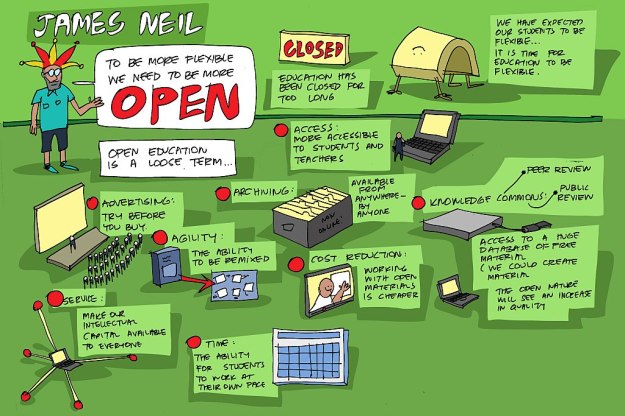
1024px-Open_education_and_flexible_learning_-_Graphic_illustration
Source: https://en.wikipedia.org/wiki/Open_education#/media/File:Open_education_and_flexible_learning_-_Graphic_illustration.jpg

The paper argued that open practices have many facets and are complex, they are not new but are having an increasingly impact in education as a result of new digital technologies and in particular how people are deploying social media. There is a lot of rhetoric around the potential of open practices and naïve assumptions about their impact, but it is important to caution against this; they are not inherently good in themselves, but it is more to do with how they are appropriated. In other words, the nature of and benefits of open practices depends on the context, i.e. how they are applied and implemented. Cronin (2017) argues that the use of open practices by learners and educators is complex, personal, and contextual; it is also continually negotiated. Higher Education institutions require collaborative and critical approaches to openness in order to support academics, students, and learning in an increasingly complex Higher Education environment. Olcott (2013) argues that openness and open education needs to be viewed along a continuum with varying degrees of openness and access to knowledge as the guiding core principle.

kaleidoscope-art-1696491_960_720
Source: https://pixabay.com/en/kaleidoscope-pattern-kaleydograf-1696491/

Building on these perspectives we argue that openness is fluid, constantly evolving and can be understood using the metaphor of a kaleidoscope where different shapes, colours and patterns come together as visually attractive images, but they can change before your eyes and often in unpredictable ways. In order to critically read the different change forces and competing and co-existing perspectives influencing the Open Education movement, and the images they produce when mixed together, a type of double vision is required, which combines both a political and pedagogical lens. This bifocal view endeavours to strike a balance between the language of opportunity, firmly anchored in the mission of equity and opening access, set against a deeper level of critique.

The paper concludes by arguing that OER and MOOCs are important as they get us to think more about the learner experience and they challenge traditional educational offerings. However, more needs to be done to increase the uptake and use of OER and MOOCs anchored within sound pedagogical models. We need to more deeply understand what new digital literacies are needed to harness the open practice affordances of new digital technologies, particularly in terms of achieving the goal of education for all. There remains a distinct lack of discourse on OER and MOOCs at policy and strategy level and this urgently needs to be addressed if we are to truly promote the openness agenda. We also need to focus more on the development of senior educational leaders with an understanding of digital technologies and a vision for OEPs. There are also financial implications; institutions need to understand why they are investing in OER and MOOCs and how to evaluate their efforts. Importantly, we are teaching students for an uncertain future, to do jobs that we are being told may not even exist in the future. Therefore, we need to go beyond knowledge recall to develop the skills and competencies they need for life-long learning in the 21stCentury to be critical thinkers, critical consumers and critical citizens.

References

Chi, M.T.H., & Wylie, R. (2014), The ICAP Framework: Linking Cognitive Engagement to Active Learning Outcomes, Educational Psychologist, 49:4, 219-243.

Conole, G. (2016), The 7Cs of Learning Design, in J. Dalziel (Ed.), Learning Design – state of the art of the field, London: Routledge.

Cronin, C. (2017), Open education, open questions, EDUCAUSE review, available online at https://er.educause.edu/articles/2017/10/open-education-open-questions, last accessed 28thJune 2018.

Olcott, D. (2013), Access under siege: Are the gains of open education keeping pace with the growing barriers to university access?, Open Praxis, Vol. 5, Issue 1, 15-20, available online at https://openpraxis.org/index.php/OpenPraxis/article/view/14/3, last accessed 28thJune 2018.

Puentedura, R.R. (2013), SAMR and TPCK: an introduction, available online at http://www.hippasus.com/rrpweblog/archives/2013/03/28/SAMRandTPCK_AnIntroduction.pdf